
Start with what life feels like now
What if mood, thinking and physical symptoms overlap?
We help people with depression or anxiety that disrupts daily life by considering mental and physical symptoms together so that they can work toward participating in relationships and routines again.
How we look at the whole picture
You have tried to explain how difficult ordinary days have become, and you may have already tried more than one approach.
Sleep, concentration, energy and physical symptoms may be adding to what you are carrying.
You do not need to know which treatment to ask for. Start with what has changed and what you want to be able to do again.
In their own words
We understand your experience of Neuropsychiatric Recovery
People often describe it in their own words long before anyone gives it a name. If one of these sounds like you, you are in the right place.

“My depression and anxiety haven’t responded to multiple medications or therapies.”

“My psychiatric symptoms seem to track with inflammation, infection, or physical illness.”

“I’ve been told it’s psychiatric, but something neurological also seems to be going on.”

“My cognitive function is declining alongside my mood and anxiety.”
Illustrative experiences, in the words people commonly use. The portraits are AI-generated and do not show patients.
The 7 Domains of Recovery™
Your symptoms may belong in the same conversation.
Psychological health is one of seven domains, not an isolated part of you. We consider how mood, cognition, sleep, physical symptoms and circumstances affect each other.
Neuregen's proprietary 7 Domains of Recovery framework organizes that conversation around seven connected parts of your life and health. We consider all seven, then focus the evaluation on the questions your history raises.
Explore our clinical framework- 1Brain function & neural networks
What has changed in your memory, concentration, balance or sensory tolerance?
- 2Autonomic & nervous system regulation
What happens when you stand, move, rest or encounter stress?
- 3Immune function & neuroinflammation
What immune history, reactions or symptoms need a closer look?
- 4Brain energy & metabolic health
What affects your energy through the day and after activity?
- 5Structure, stability & body-to-brain signals
How do pain, posture, movement and stability affect what you can do?
- 6Psychological flexibility & behavioral recovery
How are mood, stress and patterns of coping affecting your day?
- 7Life, relationships & environment
What demands, relationships and support shape your recovery?
A plan starts with the things you want to do again.
We review your history, current symptoms, previous responses and priorities. You and the clinical team discuss the options, tradeoffs and how progress will be assessed.
01
Tell us what you want your life to look like
We start with what has changed, what you have tried, and the activities you most want to return to.
02
Answer the questions the history leaves open
We review prior reports and select relevant assessments. You should understand what each assessment is meant to clarify.
03
Agree on the priorities and the first steps
We discuss the findings, possible approaches, costs and practical constraints. The plan sets an order that fits your situation.
04
Check what changes and adjust together
We compare your response with the starting point, including daily function. If something is not helping, we discuss what needs to change.
Only then do we discuss which therapies, if any, belong in your plan. The choice depends on the findings, the evidence, your preferences and how you respond.
Talk through your situationRecovery Pathway
Neuropsychiatric Recovery
When psychiatric symptoms have a neurological substrate that hasn’t been addressed
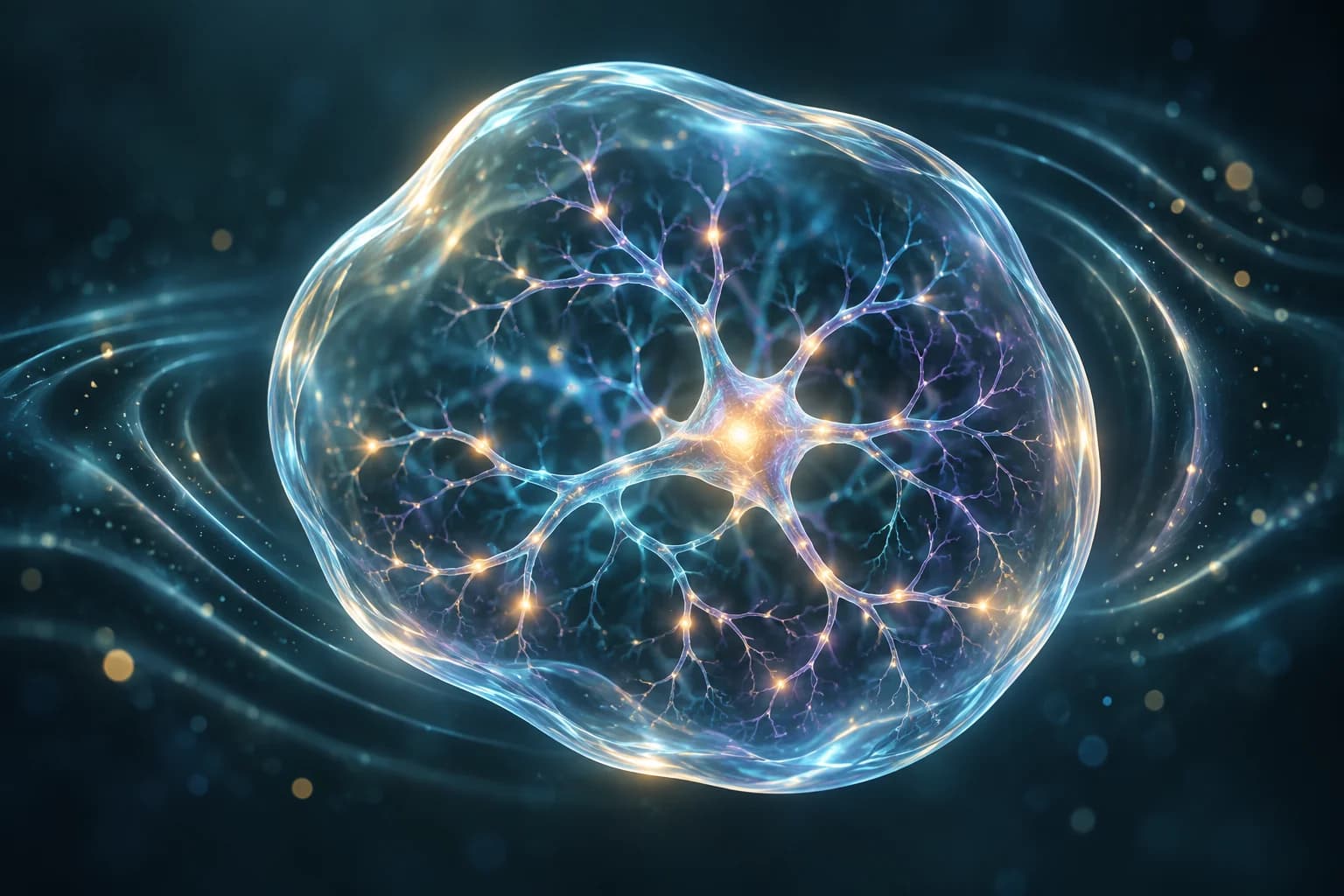
Conceptual artwork for the care discussion. Individual findings and treatment options require clinical evaluation.
What is happening in your nervous system
Neuropsychiatric illness reflects the deep integration of the brain’s emotional and regulatory circuits with its immune, autonomic, and metabolic substrates. Domain 6 (Psychological Flexibility & Behavioral Recovery) is the surface presentation — depression, anxiety, treatment resistance. Domain 1 (Brain Function & Neural Networks) underlies it: disrupted network connectivity between prefrontal, limbic, and brainstem circuits. Domain 2 (Autonomic Regulation) contributes when chronic sympathetic overactivity sustains the neuropsychiatric state. Domain 3 (Immune Function & Neuroinflammation) is increasingly recognized as a driver of treatment-resistant depression — cytokine-mediated neuroinflammation disrupts serotonin synthesis and prefrontal-limbic regulation.
Domains most involved:
Every plan starts from the same map: the 7 Domains of Recovery.
How it fits your plan
We evaluate all four primary domains and identify the neurological substrate contributing to the psychiatric presentation. The program integrates psychiatric management with neurorehabilitation, autonomic regulation, and — where the inflammatory picture is prominent — immune-directed care. Ketamine and KAP are considered where treatment resistance is established and the clinical picture supports them. We sequence from most established to more advanced, escalating only when the evidence and the patient’s course support it. We default to the simplest, lowest-risk intervention that can move a domain forward — and escalate to more advanced or interventional care only when the evidence and the patient’s course support it.
We review your history, explain the findings, agree on next steps and check how you respond.
Potential Therapies
We use established medicine where it works, and emerging medicine where it makes sense.
These are options to discuss after evaluation, not a predetermined treatment plan. Each label refers to the condition or indication described beside that therapy; evidence can differ for another use. An evidence label does not mean FDA approval.
- Psychiatric Management & PsychotherapyEvidence: Established
Foundation of Domain 6 intervention; integrated throughout the program.
- NeurorehabilitationEvidence: Established
Addressing Domain 1 network dysfunction underlying the psychiatric picture.
- Autonomic RegulationEvidence: Established
HRV biofeedback and vagal retraining for Domain 2 contributors.
- Ketamine Therapy (Depression & Anxiety)Evidence: Emerging
In treatment-resistant presentations; evidence-labeled per guide Part 7.
- Ketamine-Assisted Psychotherapy (KAP)Evidence: Emerging
Psychiatric integration of ketamine within a structured psychotherapy program.
- Integrative PsychiatryEvidence: Established
Psychiatric evaluation, medication management, and psychotherapy; the Domain 6 foundation that every advanced tool is built on.
- Alcohol Use Disorder RecoveryEvidence: Established
When alcohol craving is part of the picture, the AUD flagship carries the dedicated program.
Where the evidence stands
Evidence varies by therapy and by condition. Each therapy on this page carries its own evidence label for this condition, from established to investigational.
How we grade evidence
Frequently asked questions
What is neuropsychiatric illness?
Neuropsychiatric illness occurs at the boundary of neurology and psychiatry — where cognitive, mood, and behavioral symptoms have a demonstrable neurological substrate. This includes treatment-resistant depression with neuroinflammatory underpinnings, anxiety with autonomic drivers, and psychiatric presentations that track with neurological events such as infection, injury, or immune activation.
Is ketamine an established psychiatric treatment?
Ketamine and esketamine have established evidence for treatment-resistant depression (FDA-approved for esketamine). At Neuregen, ketamine therapy is labeled as emerging for specific neuropsychiatric indications and always applied within a psychiatrically integrated program, not as a standalone infusion.
How does neuroinflammation cause psychiatric symptoms?
Cytokines and other inflammatory mediators impair serotonin synthesis, disrupt prefrontal-limbic connectivity, and reduce tryptophan availability. Neuroinflammatory depression is increasingly recognized as a distinct subtype — one that often does not respond to standard antidepressants but may respond to anti-inflammatory approaches.
Is Neuregen replacing my psychiatrist?
No. Neuregen focuses on the neurological and autonomic dimensions that psychiatry alone may not fully address. We work alongside your existing psychiatric care — not against it.
Start with a Strategy Consultation
A real clinical conversation, not a sales call. We review your history, answer your questions, and discuss with you whether Neuregen is the right fit.
8090 N. 85th Way, Suite 100, Scottsdale, AZ 85258 · Mon–Thu, 9:00 AM – 5:30 PM