
Start with what life feels like now
How can movement and stability affect nervous-system function?
We help people with movement or endurance that limits daily life by examining physical function and related systems so that they can work toward more independent activity.
How we look at the whole picture
Stairs, carrying groceries or getting through a day on your feet takes more out of you than before.
You need a plan that starts at what you can do now, rather than assuming you can push through.
You do not need to know which treatment to ask for. Start with what has changed and what you want to be able to do again.
The 7 Domains of Recovery™
Your symptoms may belong in the same conversation.
Movement depends on strength, balance, sensory information, energy and tolerance for activity. We consider those connections within the seven domains.
Neuregen's proprietary 7 Domains of Recovery framework organizes that conversation around seven connected parts of your life and health. We consider all seven, then focus the evaluation on the questions your history raises.
Explore our clinical framework- 1Brain function & neural networks
What has changed in your memory, concentration, balance or sensory tolerance?
- 2Autonomic & nervous system regulation
What happens when you stand, move, rest or encounter stress?
- 3Immune function & neuroinflammation
What immune history, reactions or symptoms need a closer look?
- 4Brain energy & metabolic health
What affects your energy through the day and after activity?
- 5Structure, stability & body-to-brain signals
How do pain, posture, movement and stability affect what you can do?
- 6Psychological flexibility & behavioral recovery
How are mood, stress and patterns of coping affecting your day?
- 7Life, relationships & environment
What demands, relationships and support shape your recovery?
A plan starts with the things you want to do again.
We ask which activities you want to return to and assess your current function. Those findings guide a starting level and the changes we will monitor.
01
Tell us what you want your life to look like
We start with what has changed, what you have tried, and the activities you most want to return to.
02
Answer the questions the history leaves open
We review prior reports and select relevant assessments. You should understand what each assessment is meant to clarify.
03
Agree on the priorities and the first steps
We discuss the findings, possible approaches, costs and practical constraints. The plan sets an order that fits your situation.
04
Check what changes and adjust together
We compare your response with the starting point, including daily function. If something is not helping, we discuss what needs to change.
Only then do we discuss which therapies, if any, belong in your plan. The choice depends on the findings, the evidence, your preferences and how you respond.
Talk through your situationDomain 5 of 7
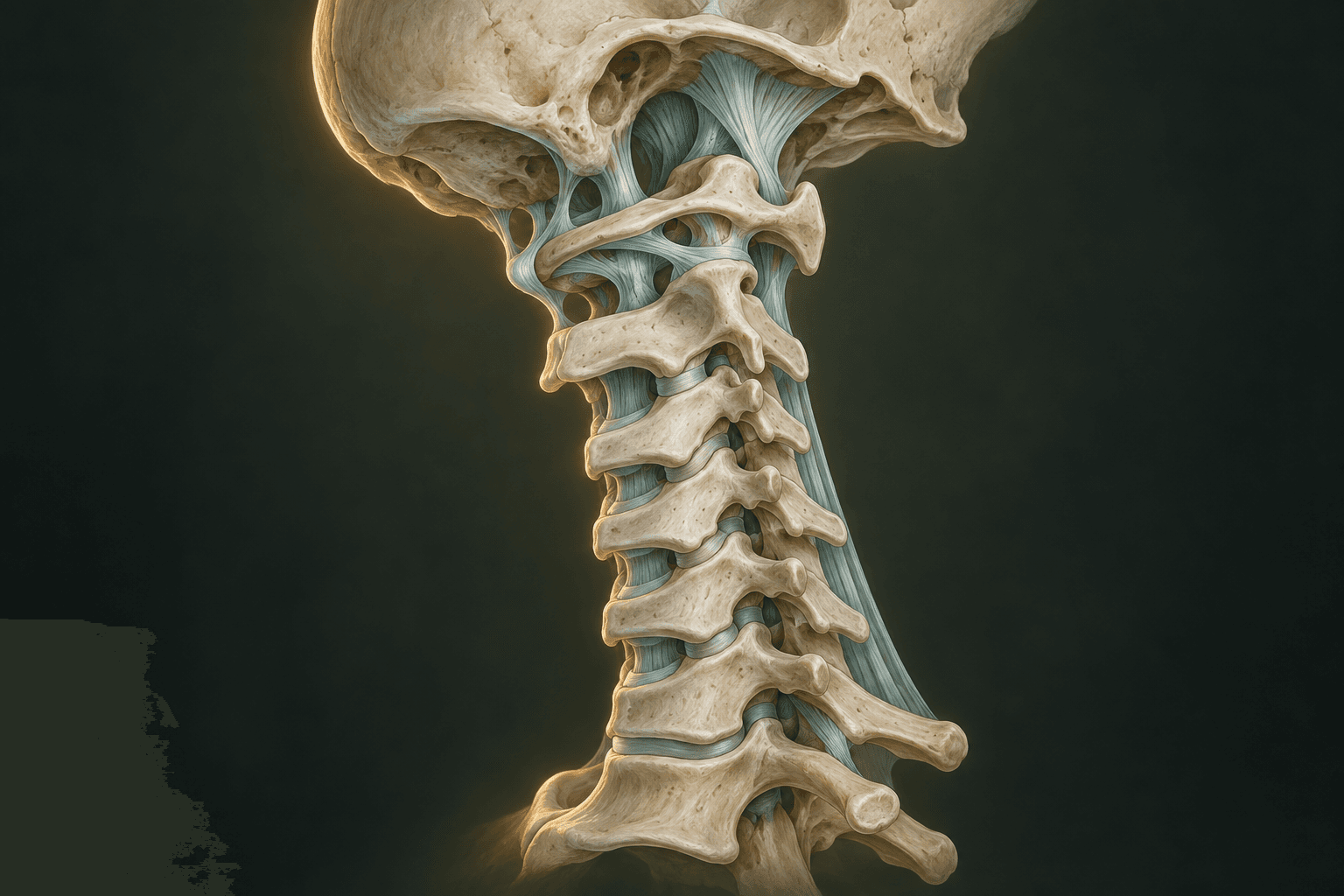
Structure, Stability & Body-to-Brain Signals
Stabilizing the body's physical inputs and structural alignment
What this domain covers
The key question: Is the quality of physical information entering the brain accurate?
Examines cervical spine stability, peripheral/cranial nerves, proprioception, vestibular balance, and joints. Structural misalignment sends continuous stress signals to the brainstem.
Conditions this domain leads
Signs this domain may be involved
Cervical instability, vagus/cranial nerve dysfunction, peripheral nerve sensitization, Craniocervical Instability (CCI), hypermobility/EDS.
How Neuregen assesses and treats it
- Precision cervical alignment and stabilization support
- Vagus nerve decompression and cranial nerve therapy
- Proprioceptive re-education and vestibular rehabilitation
- Myofascial release and joint hypermobility stabilization
Watch the explainer
Narrated explainer for Domain 5: structural alignment and body-to-brain signals, the question Neuregen asks, and the goal of a stable cranio-cervical junction.
What recovery in this domain looks like
Stable cranio-cervical junction, decompressed cranial nerves, and accurate spatial orientation.
Treatments that may be used
Specific interventions depend on your assessment findings and are always directed by our clinical team.
Frequently asked questions
What does "body-to-brain signals" mean?
The brain depends on accurate sensory information from the body — from the cervical spine, peripheral nerves, proprioceptive receptors, and vestibular system. Structural misalignment sends continuous stress signals to the brainstem, disrupting the broader recovery process.
What conditions are associated with Domain 5?
Domain 5 leads for craniocervical instability, Ehlers-Danlos and hypermobility-related dysfunction, chronic low-back pain, and post-surgical or post-cancer-treatment nerve pain: the domain most likely to need a regenerative injection or an interventional step. It also covers vagus and cranial nerve dysfunction and peripheral nerve sensitization.
What does Neuregen evaluate in this domain?
Assessment examines cervical spine stability, peripheral and cranial nerves, proprioception, vestibular balance, and joint function.
What does recovery in this domain look like?
The goal is a stable cranio-cervical junction, decompressed cranial nerves, and accurate spatial orientation.
How does Domain 5 connect to the others?
Structural signals enter the brainstem and affect autonomic tone (Domain 2), brain function (Domain 1), and psychological state (Domain 6). Persistent structural stress can block progress in every other domain.
Is a Strategy Consultation the right first step?
Yes. The Strategy Consultation with our clinical team is the starting point. Neuregen is out-of-network, and the consultation clarifies what a structural and neurological assessment would involve.
Start with a Strategy Consultation
A real clinical conversation, not a sales call. We review your history, answer your questions, and discuss with you whether Neuregen is the right fit.
8090 N. 85th Way, Suite 100, Scottsdale, AZ 85258 · Mon–Thu, 9:00 AM – 5:30 PM