
Precision Injection Therapies
Still Suffering? The Next Step Doesn’t Always Have to Be More Medication or Surgery.
When pain, instability or nerve symptoms persist — or when trauma’s imprint keeps your nervous system on high alert — we look more closely at what may be keeping you from recovering.
Neuregen’s precision injection therapies are designed for people struggling with persistent pain, instability, nerve symptoms or nervous-system dysregulation. Using image-guided procedures and selected regenerative approaches, we target specific nerves, joints, ligaments and other structures that may be limiting recovery — so you can move better, feel more stable and get back to the life pain or injury has interrupted.
See Which Approach May Fit
You plan your life around how long you can sit, stand or walk before symptoms take over.
You have tried to keep going, but a sore neck, back or joint keeps bringing you back to the same limits.
The 7 Domains of Recovery™
The Injection Targets a Structure. The Recovery Plan Looks Beyond It.
A nerve, joint or ligament may be an important treatment target—but it rarely tells the whole story. Pain and persistent symptoms can also be influenced by movement, nervous-system regulation, brain function, sleep, energy, inflammation and stress.
Neuregen’s 7 Domains of Recovery™ framework places precision injections within a broader rehabilitation strategy. We consider how the targeted structure relates to the other factors that may be limiting recovery. The goal isn’t simply to perform an injection — it’s to understand where that intervention belongs in the larger process of helping you move, function and recover.
These are goals and considerations for the whole rehabilitation plan. They are not a list of proven effects of every injection.
Brain function & neural networks
Support attention, memory and cognitive function by considering how pain, sleep and nervous-system overload may be affecting everyday thinking.
Autonomic & nervous system regulation
Work toward fewer fight-or-flight symptoms — such as anxiety, panic, palpitations and hyperarousal — and better stress tolerance within an individualized plan.
Immune function & neuroinflammation
Consider whether inflammatory or immune-related factors need evaluation and coordinated care, with the goal of reducing symptom flares and supporting a more stable internal environment.
Brain energy & metabolic health
Look at energy, sleep, metabolic health and activity tolerance to support recovery and endurance, rather than assuming pain is the only barrier.
Structure, stability & body-to-brain signals
Target pain, joint and ligament function, nerve compression, movement and stability where the examination identifies a relevant structural problem.
Psychological flexibility & behavioral recovery
Support mood, sleep and resilience so it becomes easier to engage in rehabilitation, stay active and regain confidence as symptoms change.
Life, relationships & environment
Connect improvements in function and symptom control to the activities, roles and relationships that matter most to you.
How precision injection procedures fit into your plan
The right therapy.
The right place.
The right time.
As part of your plan.
We consider precision injection procedures when your evaluation identifies a specific reason and target for them. We review the evidence, potential benefits and risks, your goals, and how the procedure fits with the rest of your care.
An injection may address one part of the problem — but it doesn’t have to be considered in isolation. Symptoms across the 7 Domains of Recovery™, functional goals, other treatments, rehabilitation progress and your response to care help determine whether an injection makes sense — and when it makes sense.
Having appropriate procedures available in-house lets us coordinate them with your rehabilitation and other care. It can also mean more convenient scheduling, less delay between identifying a need and addressing it, and straightforward outpatient care in our dedicated procedure suites.
A Precision Injection Plan Starts With What You Want to Do Again.
- 01
Start With the Goal
Tell us what you want your life to look like.
We start with what has changed, what you have tried, and the activities pain, instability or other symptoms are keeping you from.
- 02
Identify the Target
Answer the questions your history leaves open.
We review your examination, prior imaging and relevant assessments to identify the nerves, joints, ligaments or other structures that may be contributing to the problem.
- 03
Choose the Right Approach
Decide whether — and where — an injection belongs.
We discuss the findings, treatment options, evidence, risks and alternatives. If an injection makes sense, we choose the approach and target that best fit your situation and recovery goals.
- 04
Measure & Adapt
See what changed — and decide what comes next.
We compare your response with where you started, including pain and real-world function. What improves — and what doesn’t — helps determine whether to continue, change or stop the strategy.
Read the full transcript
If your nervous system feels stuck, even when nothing's wrong, then this is for you. A stellate ganglion block is a simple injection around the C6 on the neck that is located around a bundle of nerves responsible for your fight-or-flight response. We typically use the stellate ganglion block inside a full autonomic rehabilitation program, very seldom as a standalone fix. So while this procedure has been around for some time, it's actually an emerging therapy for the treatment of PTSD and dysautonomia. Most patients are in and out within the hour. You're awake the whole time, comfortable, and we're right there with you. A lot of people notice a difference almost immediately. I find that I recommend this procedure with confidence based on what I've seen in patients and the changes that it can make. We're learning more and more about just how many conditions and how many symptoms are promoted by an overactive sympathetic nervous system, that fight-or-flight nervous system. If you're curious whether this is right for you, let's talk about it.
Precision Injection Therapies
The Right Therapy. Delivered to the Right Place. For the Right Reason.
Precision injection therapy is not one procedure. It is a way of using imaging, anatomy and clinical evidence to place a carefully selected therapy where it may be most useful — whether the target is a joint, ligament, tendon, peripheral nerve, spine-related structure or part of the autonomic nervous system.
At Neuregen, every procedure begins with three questions: What are we trying to change? Where is the target? And what should we inject?
What are we injecting?
Options range from established medications to regenerative and emerging biologic approaches.
Depending on your condition and the evidence, these may include local anesthetics, anti-inflammatory medications, dextrose-based prolotherapy or perineural solutions, platelet-rich plasma (PRP), A2M, and other autologous or biologic preparations containing naturally occurring signaling or growth factors.
When investigational or cell-derived approaches are discussed, we explain their evidence, regulatory status, uncertainties and alternatives before treatment.
How are we delivering it?
Procedures take place in Neuregen’s dedicated procedure suites. Ultrasound or other imaging is used when appropriate to visualize anatomy, identify the target and guide placement.
For procedures we perform in-office, no separate hospital or surgery-center visit is needed. Appointments are designed around comfortable, convenient outpatient care, without the traditional early-morning “procedure day” experience.
We use the best available evidence, with a focus on safety, accuracy and your comfort.
What are we targeting?
Targets may include painful or degenerative joints, ligament laxity, nerve entrapment, spine-related structures, and autonomic or trauma-related nervous-system dysregulation.
Approaches include PRP and regenerative joint injections, prolotherapy, perineural injection therapy, peripheral and cervical hydrodissection, stellate and lumbar sympathetic blocks, medial branch procedures, and our Regenerative Low Back Makeover™.
When clinically appropriate and supported by evidence, our preference is to support tissue repair and natural healing alongside pain and inflammation management.
One injection menu. Different clinical targets.
The 7 Domains of Recovery™ help us decide what we are trying to change, whether an injection belongs in the plan, and what should happen around it to support meaningful recovery.
Imaging-Guided Injection Therapies
Established procedures where they’re more likely to work.
Emerging procedures where they make sense.

- Rehabilitation-focused care
- Seven-domain evaluation
- Clinician-reviewed plans
- Evidence-level labeled
- Transparent fee structure
Precision Injection Therapies
These are potential applications to discuss after your evaluation, not a predetermined treatment plan. Evidence differs by indication and continues to evolve. An evidence label does not mean FDA approval.
Local anesthetic near sympathetic nerves in the neck, considered for selected pain, stress-related and autonomic presentations.
Evidence by indication for Stellate Ganglion Block (SGB) Indication Evidence level PTSD Emerging Insomnia Preliminary Non-viral POTS Preliminary Generalized anxiety Preliminary Menopausal hot flashes Moderate Long COVID dysautonomia Preliminary Selected sympathetically mediated pain conditions Established Learn moreEvidence notes & sources for Stellate Ganglion Block (SGB)
PTSD trials are mixed; VA/DoD guidance finds insufficient evidence to recommend for or against SGB. POTS, anxiety and Long COVID reports are largely uncontrolled. Hot-flash trials support selected symptom outcomes, not a general autonomic “reset.” CRPS results vary across studies.
Places dilute dextrose or another selected solution around a peripheral nerve to address nerve-related pain.
Evidence by indication for Perineural Injection Therapy Indication Evidence level Carpal tunnel syndrome Moderate Rotator cuff tendinopathy (nerve-related shoulder pain) Emerging Other tendinopathy-related pain Preliminary Post-surgical nerve pain Preliminary Learn moreEvidence notes & sources for Perineural Injection Therapy
The strongest data here concern ultrasound-guided dextrose around the median nerve in carpal tunnel syndrome. A small shoulder trial does not establish benefit for Achilles or elbow tendinopathy. Evidence for other superficial perineural techniques and post-surgical pain remains limited.
Image-guided fluid placement to separate an entrapped nerve from adjacent tissue and improve its ability to glide.
Evidence by indication for Nerve Hydrodissection Indication Evidence level Carpal tunnel syndrome Moderate Ulnar neuropathy at the elbow Emerging Tarsal tunnel syndrome Preliminary Learn moreEvidence notes & sources for Nerve Hydrodissection
Evidence depends on the nerve, solution and technique. Carpal tunnel and ulnar-nerve trials include perineural dextrose; they do not isolate a mechanical effect or establish benefit at every entrapment site. Tarsal tunnel evidence is limited.
Targets selected nerves and tissue planes in the neck when the examination identifies a relevant source of persistent symptoms.
Evidence by indication for Cervical Plexus Hydrodissection Indication Evidence level Cervicogenic headache Preliminary Refractory cervical (neck) pain Preliminary Post-whiplash neck pain Preliminary Post-neck-dissection / scar pain Preliminary PTSD / anxiety Investigational Learn moreEvidence notes & sources for Cervical Plexus Hydrodissection
These targets and techniques are not interchangeable with SGB or a greater occipital nerve block. Cervical evidence is limited and often indirect. Published PTSD evidence includes a case report; benefit has not been established.
Uses preparations from your own blood. Evidence differs between platelet-rich plasma (PRP), A2M and the condition being treated.
Evidence by indication for PRP / A2M Indication Evidence level Knee osteoarthritis — PRP Moderate Knee osteoarthritis — A2M Emerging Hip & shoulder osteoarthritis — PRP Emerging Patellar tendinopathy — PRP Emerging Tennis elbow — PRP Emerging Spinal ligament / sacroiliac instability — PRP Preliminary Diabetic ulcers / wound healing — PRP Emerging Learn moreEvidence notes & sources for PRP / A2M
PRP studies vary by preparation and comparator, including negative placebo-controlled trials. A2M has limited knee-specific trial data; PRP findings cannot be assigned to A2M. A large trial found no benefit from a single PRP injection for chronic midportion Achilles tendinopathy. Wound applications require a separate wound-care assessment.
A coordinated approach combining selected image-guided procedures with rehabilitation for complex, multifactorial low-back pain.
Evidence by indication for Regenerative Low Back Makeover™ Indication Evidence level Recurring, multifactorial low-back pain (combined program) Investigational Learn moreEvidence notes & sources for Regenerative Low Back Makeover™
Evidence for an individual treatment does not validate a combined or branded program. The program as a whole has not been established by controlled trials; each proposed intervention needs its own rationale and follow-up.
Uses dextrose-based injections with the aim of supporting a local repair response around selected joints, ligaments or tendons.
Evidence by indication for Prolotherapy Indication Evidence level Iliolumbar / sacroiliac ligament-related pain Preliminary Cervical ligament laxity Preliminary Chronic low-back pain Emerging Hypermobile Ehlers–Danlos syndrome (hEDS) Preliminary Recurrent peripheral joint instability (EDS-associated) Preliminary Knee ligamentous laxity Preliminary Learn moreEvidence notes & sources for Prolotherapy
Pain relief does not prove ligament repair or restored stability. The VA review found little to no benefit for intra-articular knee dextrose versus saline on key outcomes; evidence for low-back applications was very uncertain. Evidence in hEDS includes a small shoulder case series, not proof of whole-body benefit.
Places local anesthetic, sometimes with a corticosteroid, around the greater occipital nerve to reduce selected headache pain signals.
Evidence by indication for Greater Occipital Nerve (GON) Block Indication Evidence level Cluster headache (transitional treatment) Moderate Chronic & episodic migraine Moderate Chronic daily / medication-overuse headache Emerging Occipital neuralgia Emerging Cervicogenic headache Emerging Post-traumatic headache (concussion) Preliminary Learn moreEvidence notes & sources for Greater Occipital Nerve (GON) Block
Cluster-headache guidance supports GON blocks for transitional relief. Evidence varies with headache diagnosis, injectate and outcome duration. Medication-overuse headache still requires a plan for the overused medication; a block does not replace that care.
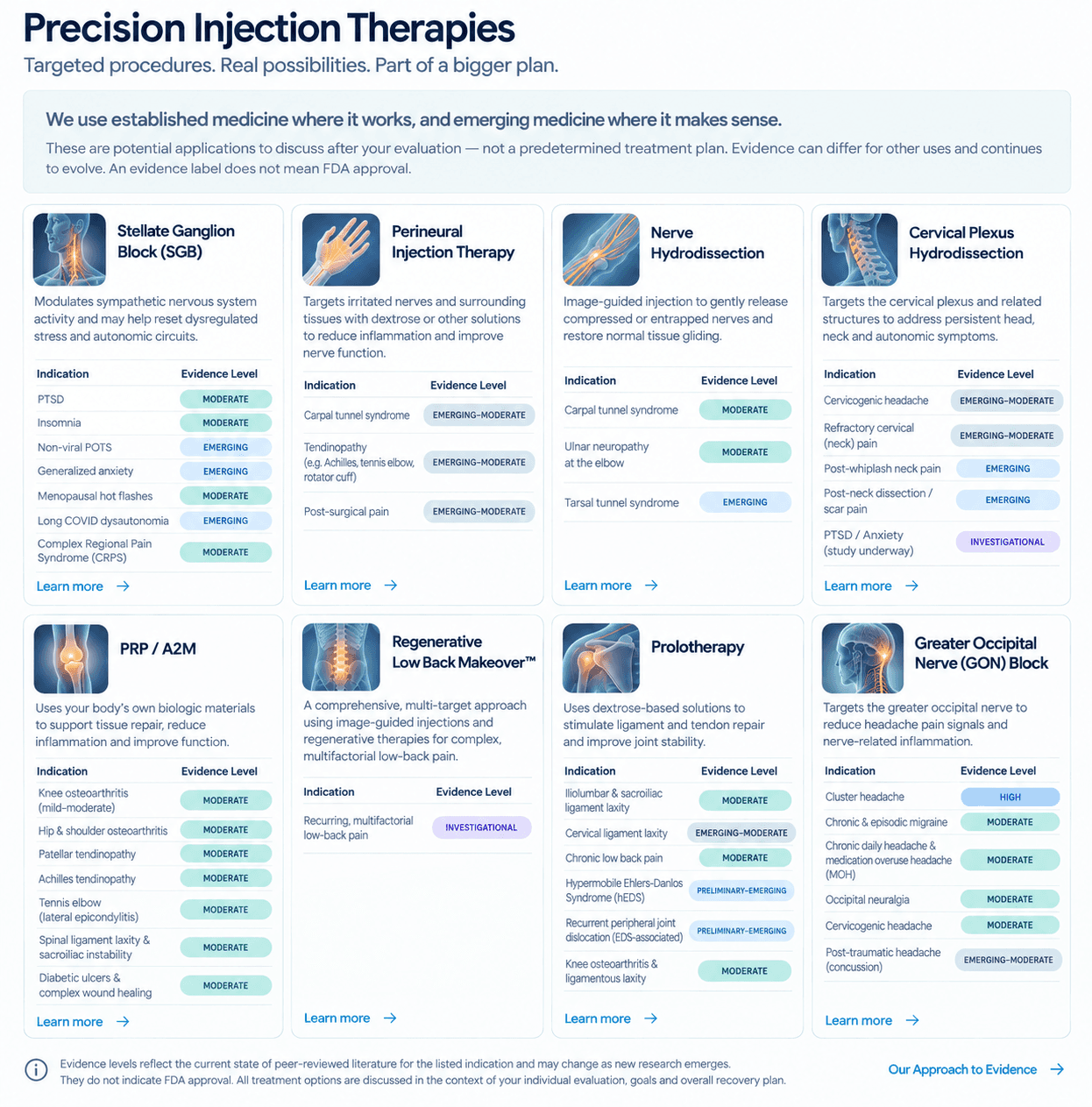
Labels summarize the evidence for the listed use; they are not formal guideline grades or FDA approval. Your evaluation, goals and overall recovery plan guide treatment decisions.
Our Approach to EvidenceLearn More About Neuregen’s Precision Guided Injection Therapies
Stellate Ganglion Block
How SGB works, who it helps, and where it fits your plan.
SGB for POTS & Dysautonomia
Preliminary evidence for autonomic nervous system dysregulation.
SGB for PTSD & Trauma
Emerging evidence for sympathetic overactivity in trauma.
Cost & Pricing
How SGB is priced and what to expect at your consultation.
Cervical Hydrodissection
Ultrasound-guided release of entrapped cervical nerves and fascia.
Greater Occipital Nerve Block
Occipital neuralgia, migraine and cervicogenic headache.
Image-Guided Injections
How ultrasound guidance makes every injection in this hub specific.
The Autonomic Reset Program
SGB paired with a structured autonomic rehabilitation arc.
FAQ
All questions about precision injection therapies.
Our Commitment to Transparency
Where the Evidence Stands
We combine established medicine with carefully selected emerging approaches — and we believe you should understand the difference.
We show an evidence level for the specific use of a therapy, not simply the therapy itself, so you know how much clinical evidence supports an option and where uncertainty remains.
Our role is to explain the evidence, risks and alternatives — then help you make an informed decision based on your goals and individual circumstances.
Our Evidence Levels
Each level describes the evidence for a particular treatment and use. It does not guarantee a specific outcome or indicate FDA approval.
| Level | Label | What It Means |
|---|---|---|
| Level 1 | Strong | Multiple high-quality studies consistently support meaningful benefit for this use. |
| Level 2 | Moderate | Good clinical evidence supports benefit, but important uncertainty remains. |
| Level 3 | Emerging | Early clinical evidence suggests potential benefit, but is not yet strong or consistent. |
| Level 4 | Preliminary | Evidence is limited to small studies, observational data or indirect clinical evidence. |
| Level 5 | Investigational | There is a rationale or very early evidence, but clinical benefit has not been established. |
Procedure Fees
Clear Fees. No Predetermined Treatment Packages.
Before you proceed with a procedure, we explain why we are recommending it, what it is intended to address, the alternatives, and what it will cost. When more than one treatment may be appropriate, the plan — and the number or sequence of procedures — is guided by your goals, findings and response to care.
| Procedure | Fee Information |
|---|---|
| Stellate Ganglion Block (SGB) | View SGB FeesConfirmed in writing at your Strategy Consultation.
|
| Perineural Injection Therapy (PIT) | View PIT FeesConfirmed in writing at your Strategy Consultation. We confirm the recommended procedure, what is included and the fee before you decide to proceed. Any additional treatment is discussed based on your needs and response. Learn about perineural injection therapy |
| Peripheral Nerve Hydrodissection | View Hydrodissection FeesConfirmed in writing at your Strategy Consultation. We confirm the recommended procedure, what is included and the fee before you decide to proceed. Any additional treatment is discussed based on your needs and response. Learn about peripheral nerve hydrodissection |
| Cervical Plexus / Cervical Hydrodissection | View Cervical Procedure FeesConfirmed in writing at your Strategy Consultation. We confirm the recommended procedure, what is included and the fee before you decide to proceed. Any additional treatment is discussed based on your needs and response. Learn about cervical hydrodissection |
| Greater Occipital Nerve (GON) Block | View GON Block FeesConfirmed in writing at your Strategy Consultation. We confirm the recommended procedure, what is included and the fee before you decide to proceed. Any additional treatment is discussed based on your needs and response. Learn about GON block |
| Platelet-Rich Plasma (PRP) | View PRP FeesConfirmed in writing at your Strategy Consultation. We confirm the recommended procedure, what is included and the fee before you decide to proceed. Any additional treatment is discussed based on your needs and response. Learn about regenerative injections |
| Prolotherapy | View Prolotherapy FeesConfirmed in writing at your Strategy Consultation. We confirm the recommended procedure, what is included and the fee before you decide to proceed. Any additional treatment is discussed based on your needs and response. Learn about prolotherapy |
| Regenerative Low Back Makeover™ | View Program FeesConfirmed in writing at your Strategy Consultation. We confirm the recommended procedure, what is included and the fee before you decide to proceed. Any additional treatment is discussed based on your needs and response. Learn about the low back program |

A Word From Our Founder
A New Era of Precision Injection Medicine
One of the most exciting advances in modern medicine is our growing ability to see nerves and other structures in real time — and address them with remarkable precision.
These procedures can do very different things: modulate nervous-system activity in conditions such as trauma, desensitize painful or irritated nerves, decompress entrapped nerves, stabilize injured tissues, and deliver biologic therapies intended to support repair and regenerative signaling.
To me, that changes the question from simply ‘Where does it hurt?’ to ‘What can we precisely target to help change the way this system is functioning?’
Dr. David George
Founder, Neuregen
Relevant Training & Credentials
Dr. George is a Board-Certified Psychiatric Mental Health Nurse Practitioner (PMHNP-BC), Board-Certified Family Nurse Practitioner (FNP-BC), Certified Clinical Trauma Professional (CCTP), and Certified Brain Injury Specialist (CBIS), with 20+ years of experience in functional neurology, clinical neuroscience and rehabilitation. He has undergone extensive post-graduate training in ultrasound-guided nerve blocks, neural hydrodissection, perineural injection therapy, musculoskeletal sonoanatomy, joint and regenerative/cellular injection therapies, as well as neurodiagnostics including EMG, NCV, SSEP, IOM and VNG.
Meet Dr. George & View Full TrainingLet’s Talk About What You Want to Do Again.
A real clinical conversation, not a sales call. We review your history, answer your questions, and discuss with you whether Neuregen is the right fit.
8090 N. 85th Way, Suite 100, Scottsdale, AZ 85258 · Mon–Thu, 9:00 AM – 5:30 PM