
Start with what life feels like now
What if hypermobility affects more than your joints?
We help people with movement or endurance that limits daily life by examining physical function and related systems so that they can work toward more independent activity.
How we look at the whole picture
Stairs, carrying groceries or getting through a day on your feet takes more out of you than before.
You need a plan that starts at what you can do now, rather than assuming you can push through.
You do not need to know which treatment to ask for. Start with what has changed and what you want to be able to do again.
In their own words
We understand your experience of Ehlers-Danlos Syndrome & Hypermobility
People often describe it in their own words long before anyone gives it a name. If one of these sounds like you, you are in the right place.

“I’ve been told I’m hypermobile or have EDS, but every specialist only treats one piece of it.”

“My joints are unstable and my dizziness, brain fog, and racing heart are getting worse together.”

“I react to foods, smells, or medications and no one connects it to my hypermobility.”

“I hurt everywhere and I feel clumsy, as if my body doesn’t know where it is.”
Illustrative experiences, in the words people commonly use. The portraits are AI-generated and do not show patients.
The 7 Domains of Recovery™
Your symptoms may belong in the same conversation.
Movement depends on strength, balance, sensory information, energy and tolerance for activity. We consider those connections within the seven domains.
Neuregen's proprietary 7 Domains of Recovery framework organizes that conversation around seven connected parts of your life and health. We consider all seven, then focus the evaluation on the questions your history raises.
Explore our clinical framework- 1Brain function & neural networks
What has changed in your memory, concentration, balance or sensory tolerance?
- 2Autonomic & nervous system regulation
What happens when you stand, move, rest or encounter stress?
- 3Immune function & neuroinflammation
What immune history, reactions or symptoms need a closer look?
- 4Brain energy & metabolic health
What affects your energy through the day and after activity?
- 5Structure, stability & body-to-brain signals
How do pain, posture, movement and stability affect what you can do?
- 6Psychological flexibility & behavioral recovery
How are mood, stress and patterns of coping affecting your day?
- 7Life, relationships & environment
What demands, relationships and support shape your recovery?
A plan starts with the things you want to do again.
We ask which activities you want to return to and assess your current function. Those findings guide a starting level and the changes we will monitor.
01
Tell us what you want your life to look like
We start with what has changed, what you have tried, and the activities you most want to return to.
02
Answer the questions the history leaves open
We review prior reports and select relevant assessments. You should understand what each assessment is meant to clarify.
03
Agree on the priorities and the first steps
We discuss the findings, possible approaches, costs and practical constraints. The plan sets an order that fits your situation.
04
Check what changes and adjust together
We compare your response with the starting point, including daily function. If something is not helping, we discuss what needs to change.
Only then do we discuss which therapies, if any, belong in your plan. The choice depends on the findings, the evidence, your preferences and how you respond.
Talk through your situationNamed Condition Hub
Ehlers-Danlos Syndrome & Hypermobility
When loose connective tissue reaches the nervous system
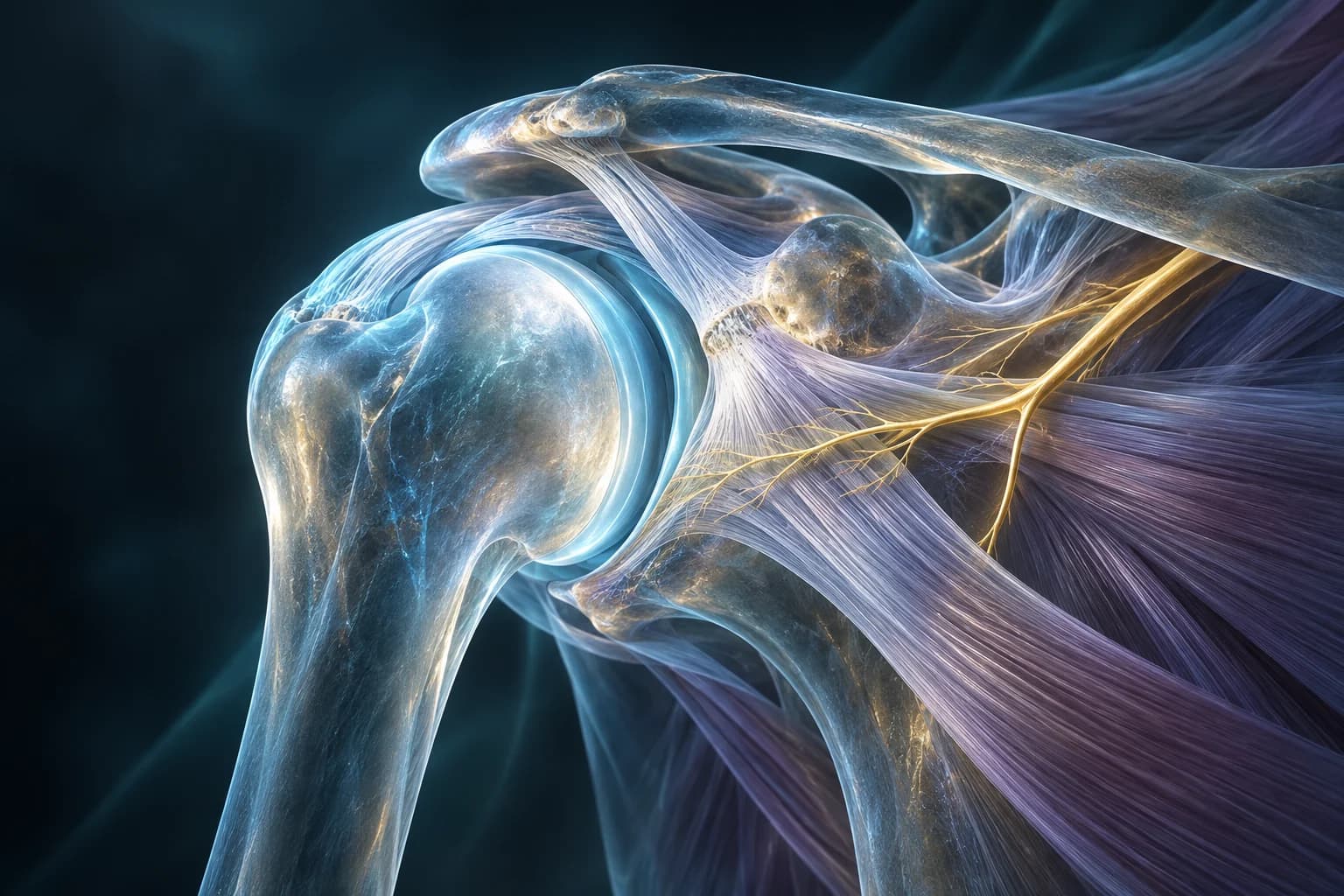
Conceptual artwork for the care discussion. Individual findings and treatment options require clinical evaluation.
What is happening in your nervous system
Connective tissue is the scaffolding of the body, and in EDS that scaffolding is built from collagen that does not hold its shape. In Domain 5 (Structure, Stability & Body-to-Brain Signals), lax ligaments mean joints move past their normal range, the cervical spine can become unstable, and the mechanoreceptors that report body position send unreliable signals. That is why proprioception, balance, and coordination are so often impaired. In Domain 2 (Autonomic Regulation), loose vascular walls pool blood in the legs on standing, which is one reason POTS and orthostatic intolerance are so common in hEDS. In Domain 3 (Immune Function & Neuroinflammation), mast cell activation appears alongside hEDS and POTS often enough that clinicians describe the three as a triad, though the mechanism connecting them is still being worked out. Chronic pain runs through all of it: joint subluxations, myofascial strain, nerve entrapment, and a nervous system that has become sensitized by years of input it could not trust.
Domains most involved:
Every plan starts from the same map: the 7 Domains of Recovery.
How it fits your plan
We start by mapping which domains are driving your presentation. The evaluation covers joint and cervical stability, vestibular and proprioceptive function, autonomic testing, and a mast cell and immune history. Where a formal hEDS or HSD diagnosis has not been made, we discuss the current diagnostic criteria with you and coordinate with genetics or rheumatology where that is appropriate. The plan then works domain by domain from the most established tools outward. Stability and proprioceptive rehabilitation protect the joints and rebuild reliable body-to-brain signaling. Autonomic rehabilitation addresses the POTS and orthostatic picture. Mast cell and immune care follows the MCAS hub. Cervical instability, when present, follows the CCI plan. Pain is addressed through neurorehabilitation and, where a specific nerve or joint is the driver, through targeted injection therapies labeled by evidence. Regenerative injections to lax ligaments are emerging, not established, and are offered only after conservative care.
We review your history, explain the findings, agree on next steps and check how you respond.
Potential Therapies
We use established medicine where it works, and emerging medicine where it makes sense.
These are options to discuss after evaluation, not a predetermined treatment plan. Each label refers to the condition or indication described beside that therapy; evidence can differ for another use. An evidence label does not mean FDA approval.
- Structural & Hypermobility AssessmentEvidence: Established
Joint, cervical, vestibular-proprioceptive, and autonomic examination as the foundation of the plan.
- Stability & Proprioceptive RehabilitationEvidence: Established
Joint protection, neuromuscular control, and balance retraining for Domain 5.
- Vestibular & Oculomotor RehabilitationEvidence: Established
For the dizziness and visual-motion symptoms that accompany cervical and proprioceptive dysfunction.
- Autonomic RehabilitationEvidence: Established
HRV biofeedback, orthostatic conditioning, and vagal retraining for the POTS picture in hEDS.
- Stellate Ganglion Block (SGB) for POTSEvidence: Preliminary
When autonomic retraining plateaus; one step inside a structured program.
- Craniocervical Instability CareEvidence: Established
When cervical instability is part of the picture, the CCI hub carries the specific plan.
- Mast Cell Activation CareEvidence: Established
For the MCAS component of the hEDS, POTS, and MCAS triad.
- Prolotherapy & PRP (lax ligaments)Evidence: Emerging
Regenerative injection for unstable joints; emerging evidence, offered with informed consent after conservative care.
Where the evidence stands
Evidence varies by therapy and by condition. Each therapy on this page carries its own evidence label for this condition, from established to investigational.
How we grade evidence
The training behind this care
Dr. David George: Board certifications and training in functional neurology, integrative psychiatry, and mental health; certified brain injury specialist.
Training most relevant to this area
- Diplomate, American Chiropractic Neurology Board (DACNB, 2005)
- Co-developer, FNOR (Functional Neuro-Orthopedic Rehabilitation)
- NASM Certified Corrective Exercise Specialist
- Fellow, International Academy of Medical Acupuncture
- MUA Certified
- Vestibular rehabilitation (VRT)
- Advanced neurodiagnostics (EMG, NCV, SSEP, IOM, VNG)
These are the founder’s qualifications. We confirm the treating clinician and their role when discussing your plan.
See Dr. George’s full credentialsFrequently asked questions
What is the difference between hEDS and hypermobility spectrum disorder?
Hypermobile Ehlers-Danlos syndrome (hEDS) is diagnosed clinically against a defined set of criteria published in 2017, because no genetic test exists for it yet. People who are symptomatic and hypermobile but do not meet the full criteria are described as having a hypermobility spectrum disorder (HSD). The nervous system consequences, and the care, are largely the same.
Does Neuregen diagnose EDS?
Neuregen evaluates the neurological, autonomic, and structural consequences of hypermobility. Where you do not yet carry a formal diagnosis, we discuss the diagnostic criteria with you and coordinate with genetics or rheumatology when that is the right next step. The care plan does not wait on a label.
Why do POTS and MCAS show up so often with EDS?
Loose vascular walls pool blood on standing, which drives orthostatic intolerance and POTS. Mast cell activation appears alongside hEDS and POTS frequently enough that clinicians describe the three as a triad. The exact mechanism linking them is still being studied, which is why each component is evaluated and treated on its own evidence.
Can Neuregen help with EDS pain?
Pain in EDS usually has several sources at once: joint instability, muscle strain from compensating, nerve entrapment, and a sensitized nervous system. Neuregen addresses each through rehabilitation, autonomic care, and, where a specific joint or nerve is the driver, targeted injection therapies labeled by their evidence.
Is regenerative injection therapy proven for EDS?
No. Prolotherapy and PRP for lax ligaments carry emerging evidence, and the evidence specific to EDS is limited. Neuregen labels them as emerging, offers them only after conservative rehabilitation, and requires explicit informed consent with no outcome guarantee.
Start with a Strategy Consultation
A real clinical conversation, not a sales call. We review your history, answer your questions, and discuss with you whether Neuregen is the right fit.
8090 N. 85th Way, Suite 100, Scottsdale, AZ 85258 · Mon–Thu, 9:00 AM – 5:30 PM