
Start with what life feels like now
Why does being upright make ordinary tasks harder?
We help people with dizziness or a racing heart by examining their symptoms together so that they can work toward standing and walking more confidently.
How we look at the whole picture
Standing in a checkout line or taking a shower can leave you lightheaded, shaky or drained.
You want to do more, but you cannot always predict what your body will tolerate.
You do not need to know which treatment to ask for. Start with what has changed and what you want to be able to do again.
In their own words
We understand your experience of POTS & Dysautonomia
People often describe it in their own words long before anyone gives it a name. If one of these sounds like you, you are in the right place.

“I feel faint, dizzy, and my heart races whenever I stand up.”

“I’ve been diagnosed with POTS but the treatment options I’ve been offered feel limited.”

“My dizziness, fatigue, and brain fog are worst when I’m upright.”

“My POTS started after a viral illness or a traumatic event.”
Illustrative experiences, in the words people commonly use. The portraits are AI-generated and do not show patients.
The 7 Domains of Recovery™
Your symptoms may belong in the same conversation.
The autonomic domain looks at responses such as heart rate and tolerance for being upright. We also consider energy, sleep, movement and the other domains that may be affecting your day.
Neuregen's proprietary 7 Domains of Recovery framework organizes that conversation around seven connected parts of your life and health. We consider all seven, then focus the evaluation on the questions your history raises.
Explore our clinical framework- 1Brain function & neural networks
What has changed in your memory, concentration, balance or sensory tolerance?
- 2Autonomic & nervous system regulation
What happens when you stand, move, rest or encounter stress?
- 3Immune function & neuroinflammation
What immune history, reactions or symptoms need a closer look?
- 4Brain energy & metabolic health
What affects your energy through the day and after activity?
- 5Structure, stability & body-to-brain signals
How do pain, posture, movement and stability affect what you can do?
- 6Psychological flexibility & behavioral recovery
How are mood, stress and patterns of coping affecting your day?
- 7Life, relationships & environment
What demands, relationships and support shape your recovery?
A plan starts with the things you want to do again.
We ask when symptoms occur, what makes them worse, how long recovery takes, and what has already been checked. Relevant examination and testing help us decide where to begin.
01
Tell us what you want your life to look like
We start with what has changed, what you have tried, and the activities you most want to return to.
02
Answer the questions the history leaves open
We review prior reports and select relevant assessments. You should understand what each assessment is meant to clarify.
03
Agree on the priorities and the first steps
We discuss the findings, possible approaches, costs and practical constraints. The plan sets an order that fits your situation.
04
Check what changes and adjust together
We compare your response with the starting point, including daily function. If something is not helping, we discuss what needs to change.
Only then do we discuss which therapies, if any, belong in your plan. The choice depends on the findings, the evidence, your preferences and how you respond.
Talk through your situationNamed Condition Hub
POTS & Dysautonomia
A POTS diagnosis is the starting line, not the finish
Clinically: Postural Orthostatic Tachycardia Syndrome and related dysautonomia — disruption of autonomic cardiovascular regulation producing orthostatic intolerance, exertional limitation, and cognitive symptoms.
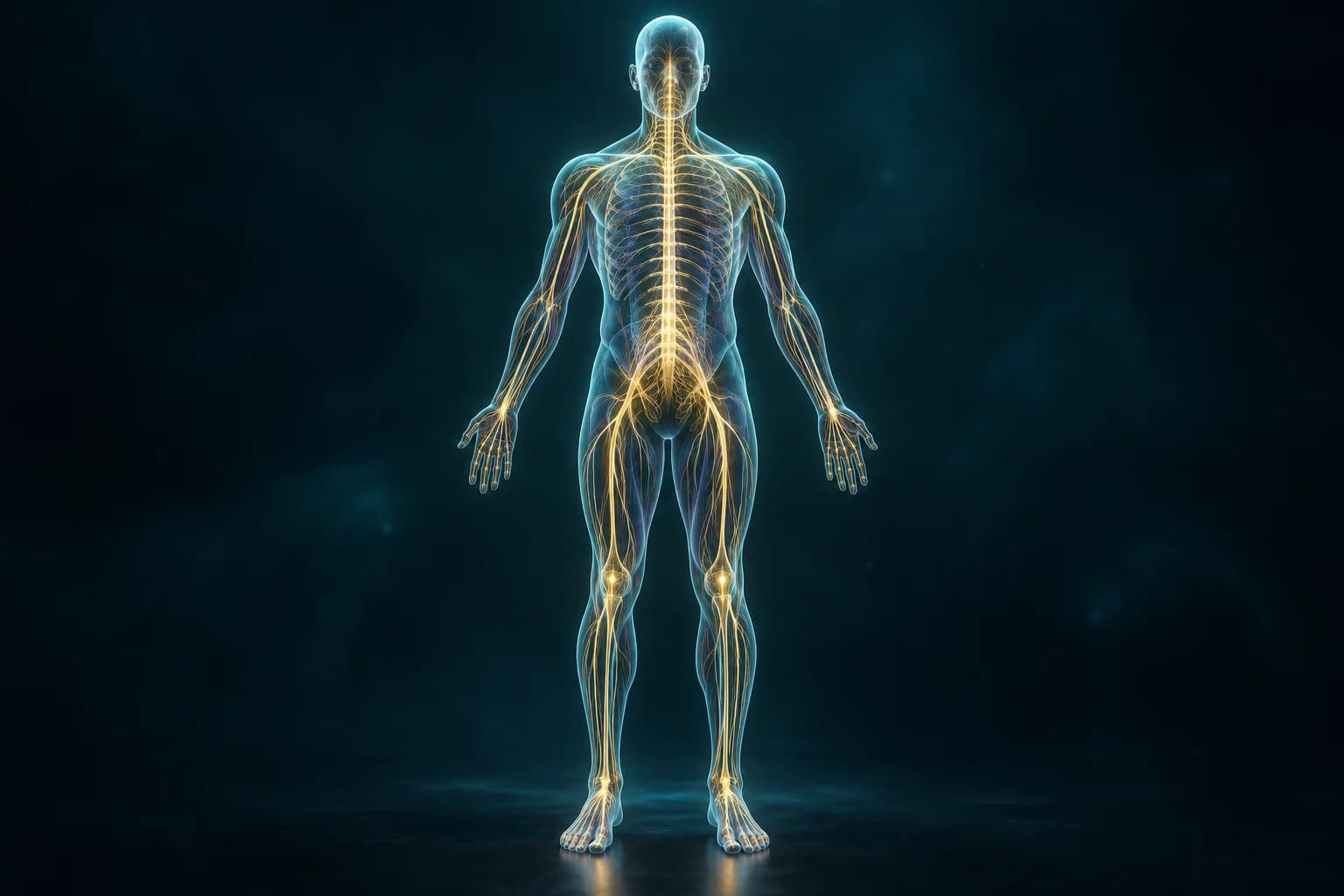
Conceptual artwork for the care discussion. Individual findings and treatment options require clinical evaluation.
What is happening in your nervous system
POTS involves disruption in the autonomic nervous system’s ability to regulate heart rate, blood pressure, and orthostatic tolerance. Domain 2 (Autonomic & Nervous System Regulation) is the primary domain: the sympathetic-parasympathetic balance is disrupted, producing postural tachycardia, orthostatic intolerance, and fatigue. Domain 5 (Structure, Stability & Body-to-Brain Signals) matters when cervical instability or connective tissue hypermobility is a contributing factor, as structural body-to-brain signals can sustain or amplify the autonomic picture. Domain 1 (Brain Function & Neural Networks) is affected when impaired cerebral blood flow during orthostatic challenge reduces cognitive function, producing the brain fog and processing difficulties many POTS patients experience. Underlying drivers — post-viral, trauma-related, immune-mediated, or structural — must be identified alongside the autonomic presentation to plan effective care.
Domains most involved:
Every plan starts from the same map: the 7 Domains of Recovery.
How it fits your plan
Evaluation begins with an autonomic screen, orthostatic vitals, HRV measurement, and structural assessment where indicated (cervical, hypermobility screen). A structured autonomic rehabilitation program is the foundation: graded reconditioning with appropriate pacing, HRV biofeedback, and fluid and electrolyte support. Stellate ganglion block for POTS and dysautonomia carries preliminary evidence — it is applied within the structured program, not as a standalone procedure. We identify whether the autonomic dysfunction is post-viral, trauma-related, immune-mediated, or structural, and address the underlying driver alongside rehabilitation. If Long COVID is the driver, the Long COVID hub page has more specific detail on the overlap.
We review your history, explain the findings, agree on next steps and check how you respond.
Potential Therapies
We use established medicine where it works, and emerging medicine where it makes sense.
These are options to discuss after evaluation, not a predetermined treatment plan. Each label refers to the condition or indication described beside that therapy; evidence can differ for another use. An evidence label does not mean FDA approval.
- Functional Neurology AssessmentEvidence: Established
Orthostatic vitals, HRV, autonomic screen, and cervical/hypermobility evaluation.
- Structured Autonomic RehabilitationEvidence: Established
Graded reconditioning, pacing, HRV biofeedback, and fluid/electrolyte support.
- Stellate Ganglion Block for POTS & DysautonomiaEvidence: Preliminary
Preliminary evidence for POTS and dysautonomia; applied within the structured program.
Where the evidence stands
Evidence varies by therapy and by condition. Each therapy on this page carries its own evidence label for this condition, from established to investigational.
How we grade evidence
Frequently asked questions
What is the difference between this POTS hub and the Autonomic Dysfunction pathway?
The Autonomic Dysfunction pathway is a symptom-pattern entry point — for patients who recognize dizziness, palpitations, and exertional intolerance but may not yet have a diagnosis. This hub is for patients who already carry a POTS or dysautonomia diagnosis and want to understand the specific program Neuregen builds around it.
Is SGB an established treatment for POTS?
Stellate ganglion block for POTS and dysautonomia is labeled as preliminary evidence at Neuregen — not yet a standard of care for this specific indication. It is applied within a structured autonomic rehabilitation program rather than offered as a standalone procedure.
Does Neuregen evaluate structural contributors to POTS?
Yes. Cervical instability and connective tissue hypermobility are recognized contributors to dysautonomia in some patients, and Domain 5 assessment includes a structural and hypermobility screen. Identifying a structural driver changes how the program is sequenced.
Can Long COVID cause POTS?
Post-viral autonomic dysregulation, including POTS, is a recognized outcome of COVID-19. If Long COVID is the context for your POTS diagnosis, the Long COVID hub has more specific information on how those presentations overlap and how Neuregen addresses them.
Start with a Strategy Consultation
A real clinical conversation, not a sales call. We review your history, answer your questions, and discuss with you whether Neuregen is the right fit.
8090 N. 85th Way, Suite 100, Scottsdale, AZ 85258 · Mon–Thu, 9:00 AM – 5:30 PM