
Start with what life feels like now
Why do movement, screens or busy places make you dizzy?
We help people with dizziness or visual strain by examining balance and eye movements together so that they can work toward reading and visiting busy places more confidently.
How we look at the whole picture
Scrolling, turning your head or walking down a supermarket aisle can make you feel unsteady.
You find yourself avoiding places or tasks that used to take no thought.
You do not need to know which treatment to ask for. Start with what has changed and what you want to be able to do again.
The 7 Domains of Recovery™
Your symptoms may belong in the same conversation.
Balance involves vision, inner-ear signals, body position and the way the brain combines them. We consider these alongside energy, stress responses and other relevant domains.
Neuregen's proprietary 7 Domains of Recovery framework organizes that conversation around seven connected parts of your life and health. We consider all seven, then focus the evaluation on the questions your history raises.
Explore our clinical framework- 1Brain function & neural networks
What has changed in your memory, concentration, balance or sensory tolerance?
- 2Autonomic & nervous system regulation
What happens when you stand, move, rest or encounter stress?
- 3Immune function & neuroinflammation
What immune history, reactions or symptoms need a closer look?
- 4Brain energy & metabolic health
What affects your energy through the day and after activity?
- 5Structure, stability & body-to-brain signals
How do pain, posture, movement and stability affect what you can do?
- 6Psychological flexibility & behavioral recovery
How are mood, stress and patterns of coping affecting your day?
- 7Life, relationships & environment
What demands, relationships and support shape your recovery?
A plan starts with the things you want to do again.
We ask about triggers and falls, review previous findings, and assess the functions involved before agreeing on exercises or other care.
01
Tell us what you want your life to look like
We start with what has changed, what you have tried, and the activities you most want to return to.
02
Answer the questions the history leaves open
We review prior reports and select relevant assessments. You should understand what each assessment is meant to clarify.
03
Agree on the priorities and the first steps
We discuss the findings, possible approaches, costs and practical constraints. The plan sets an order that fits your situation.
04
Check what changes and adjust together
We compare your response with the starting point, including daily function. If something is not helping, we discuss what needs to change.
Only then do we discuss which therapies, if any, belong in your plan. The choice depends on the findings, the evidence, your preferences and how you respond.
Talk through your situationNeurorehabilitation · Vestibular & Oculomotor
Vestibular & Oculomotor Rehabilitation
Retraining balance, gaze, and eye-movement control after concussion, vestibular injury, or dysautonomia.
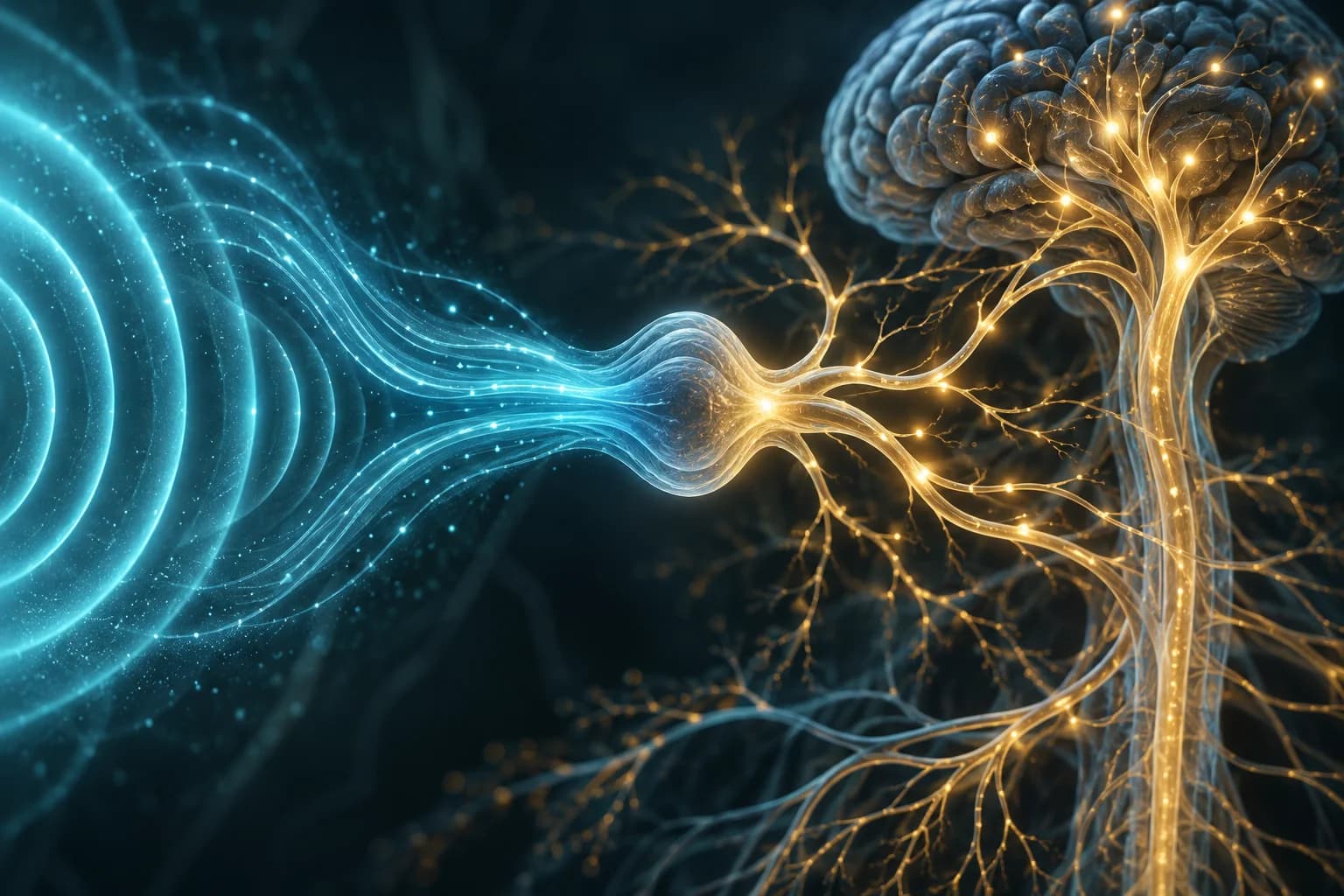
Conceptual artwork for the care discussion. Individual findings and treatment options require clinical evaluation.
What vestibular and oculomotor rehabilitation does
The vestibular system in your inner ear reports head motion to the brainstem and cerebellum. Those centers use the report to hold your eyes steady on a target while your head moves (the vestibulo-ocular reflex) and to keep you upright. Concussion, inner-ear injury, prolonged illness, and autonomic dysregulation can each disrupt that loop. The result is dizziness, visual blur with head movement, motion sensitivity, difficulty reading or scrolling, and a sense of imbalance that worsens in busy visual environments.
Assessment comes first. Videonystagmography (VNG) and oculomotor testing record how your eyes track, jump between targets, and respond to head motion, so the deficit is measured rather than inferred from symptoms. Balance and positional testing add the postural picture. The findings determine which of the standard rehabilitation categories apply: gaze stabilization to recalibrate the vestibulo-ocular reflex, habituation to reduce motion sensitivity through graded exposure, saccade and smooth-pursuit training for eye-movement control, and balance and gait work that progressively challenges postural control.
Practice guidelines from the American Physical Therapy Association support vestibular rehabilitation for peripheral vestibular hypofunction, and vestibular-oculomotor treatment is a recognized component of post-concussion care. Its use for POTS, dysautonomia, and functional neurologic disorder is emerging: the mechanism is plausible and the tools are the same, but the outcome literature is thinner. Neuregen labels those applications accordingly and measures them against the baseline testing.
Where a cervical contributor is present, as in hypermobility, cervical instability, or post-whiplash presentations, vestibular work is coordinated with the structural and physical therapy side of the plan rather than delivered in isolation.
Domains most involved:
Every plan starts from the same map: the 7 Domains of Recovery.
How it fits your plan
Balance and eye-movement work follows an assessment of the symptoms and functions involved. The exercises are chosen and paced around your findings, tolerance and other care.
The starting point is a task that has become difficult, such as reading, walking or concentrating. We assess what contributes to that difficulty across the seven domains and choose rehabilitation activities that can be adjusted to your response.
We review your history, explain the findings, agree on next steps and check how you respond.
Potential Therapies
We use established medicine where it works, and emerging medicine where it makes sense.
These are options to discuss after evaluation, not a predetermined treatment plan. Each label refers to the condition or indication described beside that therapy; evidence can differ for another use. An evidence label does not mean FDA approval.
- Videonystagmography (VNG) and oculomotor testingEvidence: Established
Records eye-movement and vestibular reflex function to locate the deficit before treatment
- Gaze stabilization exercisesEvidence: Established
Recalibrates the vestibulo-ocular reflex so vision stays clear during head movement
- Habituation and graded motion exposureEvidence: Established
Reduces motion and visual-motion sensitivity through repeated, controlled provocation
- Saccade and smooth-pursuit trainingEvidence: Established
Eye-movement control for reading, screens, and tracking moving targets
- Balance and gait retrainingEvidence: Established
Progressive postural challenges on varied surfaces and with altered visual input
- Vestibular protocols for dysautonomia and FNDEvidence: Emerging
Same tools, thinner outcome literature; applied where testing shows a deficit and tracked against baseline
Where the evidence stands
Vestibular rehabilitation is supported by clinical practice guidelines for peripheral vestibular hypofunction and by a substantial post-concussion literature. Applications to POTS, dysautonomia, and functional neurologic disorder carry an emerging label.
Sources and what they support
- Vestibular rehabilitation clinical practice guideline, 2022
The guideline addresses peripheral vestibular hypofunction. Its recommendations should not be generalized to every cause of dizziness or every neurorehabilitation tool.
How we grade evidence
Pricing
| Service | Price |
|---|---|
| Functional neurology assessment | Confirmed in writing at your Strategy Consultation |
| Neurorehabilitation programScoped after the assessment; quoted as a whole, not per visit | Confirmed in writing at your Strategy Consultation |
Neuregen is an out-of-network specialty clinic. Most therapies listed here are not covered by insurance; we provide itemized documentation you can submit to your insurer, and we tell you before any therapy which parts, if any, are typically reimbursed.
Financing options are reviewed at your Strategy Consultation before any plan is finalized.
The training behind this care
At Neuregen, rehabilitation is the organizing discipline. Cognitive, balance and physical goals are considered alongside autonomic, psychiatric and medical concerns, so the plan can account for more than one barrier to daily activity.
Dr. David George: Board certifications and training in functional neurology, integrative psychiatry, and mental health; certified brain injury specialist.
Training most relevant to this area
- Diplomate, American Chiropractic Neurology Board (DACNB, 2005)
- Co-developer, FNOR (Functional Neuro-Orthopedic Rehabilitation)
- NASM Certified Corrective Exercise Specialist
- Fellow, International Academy of Medical Acupuncture
- MUA Certified
- Vestibular rehabilitation (VRT)
- Advanced neurodiagnostics (EMG, NCV, SSEP, IOM, VNG)
These are the founder’s qualifications. We confirm the treating clinician and their role when discussing your plan.
See Dr. George’s full credentialsRelated pages
modality
condition
Frequently asked questions
How do I know if my dizziness is vestibular?
Symptoms alone cannot settle it. Dizziness after concussion or during dysautonomia can come from the inner ear, the eye-movement system, the neck, blood-pressure regulation, or a combination. VNG and oculomotor testing, together with orthostatic and cervical screening in the functional neurology assessment, separate those sources so the rehabilitation targets the one that is actually impaired.
Will the exercises make my symptoms worse at first?
Habituation work deliberately provokes mild symptoms in a controlled dose so the nervous system can adapt to them. The provocation is graded to what you can tolerate, and the plan is adjusted if symptoms are not settling between sessions. Gaze stabilization and eye-movement training are usually less provoking.
Is this the same as vestibular therapy at a physical therapy clinic?
The exercise categories overlap, and a physical therapist trained in vestibular rehabilitation delivers much of this work in conventional settings. The difference at Neuregen is the context: testing is interpreted alongside the autonomic, cervical, and cognitive findings from the same assessment, and the vestibular plan is sequenced with the rest of the recovery program, including stellate ganglion block where that is indicated.
Does vestibular rehabilitation help POTS?
Some people with POTS and dysautonomia have measurable vestibular or oculomotor deficits, and treating those deficits can reduce the motion sensitivity and visual strain that add to their symptom load. The evidence for this application is emerging rather than established, so Neuregen applies it only where testing shows a deficit and re-tests to confirm change.
Start with a Strategy Consultation
If you keep setting aside activities because of symptoms, those missed activities are the current cost. An evaluation can help establish a starting point and practical goals at a pace you can discuss with the team.
8090 N. 85th Way, Suite 100, Scottsdale, AZ 85258 · Mon–Thu, 9:00 AM – 5:30 PM