
Start with what life feels like now
Could a neck nerve problem explain part of your pain?
We help people with neck or head symptoms that interrupt daily life by examining structural and nervous-system findings together so that they can understand their options for getting moving again.
How we look at the whole picture
Turning your head, staying at a desk or holding one position can bring on pain, dizziness or trouble focusing.
You need an explanation that takes both the physical symptoms and their effect on your day seriously.
You do not need to know which treatment to ask for. Start with what has changed and what you want to be able to do again.
The 7 Domains of Recovery™
Your symptoms may belong in the same conversation.
Body position, neck function, balance, pain and autonomic responses can interact. We consider the seven domains while checking which findings need further clinical review.
Neuregen's proprietary 7 Domains of Recovery framework organizes that conversation around seven connected parts of your life and health. We consider all seven, then focus the evaluation on the questions your history raises.
Explore our clinical framework- 1Brain function & neural networks
What has changed in your memory, concentration, balance or sensory tolerance?
- 2Autonomic & nervous system regulation
What happens when you stand, move, rest or encounter stress?
- 3Immune function & neuroinflammation
What immune history, reactions or symptoms need a closer look?
- 4Brain energy & metabolic health
What affects your energy through the day and after activity?
- 5Structure, stability & body-to-brain signals
How do pain, posture, movement and stability affect what you can do?
- 6Psychological flexibility & behavioral recovery
How are mood, stress and patterns of coping affecting your day?
- 7Life, relationships & environment
What demands, relationships and support shape your recovery?
A plan starts with the things you want to do again.
We start with your symptom history and prior imaging or specialist reports. The examination guides whether further assessment, precautions or a different referral is needed.
01
Tell us what you want your life to look like
We start with what has changed, what you have tried, and the activities you most want to return to.
02
Answer the questions the history leaves open
We review prior reports and select relevant assessments. You should understand what each assessment is meant to clarify.
03
Agree on the priorities and the first steps
We discuss the findings, possible approaches, costs and practical constraints. The plan sets an order that fits your situation.
04
Check what changes and adjust together
We compare your response with the starting point, including daily function. If something is not helping, we discuss what needs to change.
Only then do we discuss which therapies, if any, belong in your plan. The choice depends on the findings, the evidence, your preferences and how you respond.
Talk through your situationPrecision Injection Therapies · Hydrodissection
Cervical Hydrodissection
An ultrasound-guided injection that frees a nerve pinned by scar tissue or tight fascia in the neck, so it can stop sending the wrong signals.
Clinically: Ultrasound-guided perineural injection of fluid around entrapped cervical and upper-thoracic nerves, applied where structural compression and neural sensitization overlap with autonomic or pain symptoms.
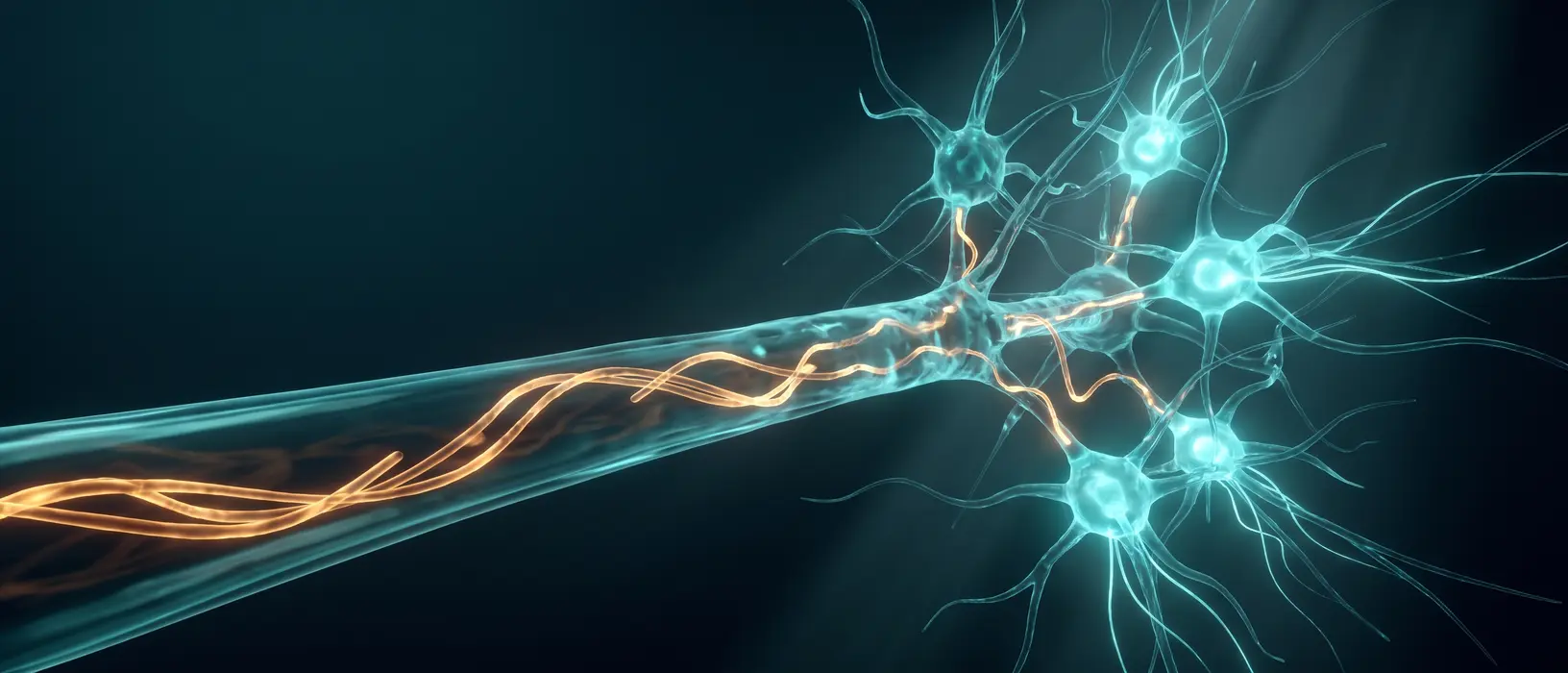
Conceptual artwork for the care discussion. Individual findings and treatment options require clinical evaluation.
The mechanism: releasing a nerve from the tissue around it
Peripheral nerves travel through tunnels of fascia and muscle. After whiplash, prolonged postural strain, surgery, or repetitive loading, those tunnels can scar or tighten and hold the nerve under constant pressure. A compressed nerve becomes irritable: it fires with less provocation, its blood supply is reduced, and the region it serves reports pain, numbness, or a sense that the head and neck never fully relax. In the neck, the greater and lesser occipital nerves, the cervical plexus branches, and the upper brachial plexus are the usual sites.
Hydrodissection addresses the compression directly. Under ultrasound, the nerve and the tissue plane around it are identified, and a fine needle delivers a volume of fluid, typically saline or dilute dextrose with or without a local anesthetic, into that plane. The fluid separates the nerve from the adhering tissue, restores space for it to glide, and reduces the mechanical irritation that keeps it sensitized. The ultrasound image confirms that the fluid is spreading around the nerve rather than into muscle.
This is a structural tool used for a nervous-system reason. Chronic cervical nerve irritation feeds sympathetic arousal and pain amplification, which is why it belongs in a plan that also addresses autonomic regulation, posture, and load. Freeing the nerve is the step that lets rehabilitation of the neck and shoulder girdle proceed without a source of ongoing irritation.
Domains most involved:
Every plan starts from the same map: the 7 Domains of Recovery.
How it fits your plan
Cervical hydrodissection is considered only after the evaluation identifies a relevant nerve problem. We review the findings, alternatives and how the procedure would fit with other care.
An injection is worth discussing only when the evaluation identifies a problem it may address. We consider that problem alongside sleep, movement, autonomic symptoms and daily function, then explain what rehabilitation would involve with or without the procedure.
We review your history, explain the findings, agree on next steps and check how you respond.
Potential Therapies
We use established medicine where it works, and emerging medicine where it makes sense.
These are options to discuss after evaluation, not a predetermined treatment plan. Each label refers to the condition or indication described beside that therapy; evidence can differ for another use. An evidence label does not mean FDA approval.
- Ultrasound-guided perineural hydrodissectionEvidence: Emerging
Saline or dilute-dextrose injection into the fascial plane around an entrapped nerve; the specific agent is set by our clinical team per case.
- Diagnostic ultrasound and neurodiagnostic testingEvidence: Established
Used before the procedure to confirm the entrapment site and after it to document nerve mobility.
Where the evidence stands
Ultrasound-guided perineural injection is a recognized technique in regional anesthesia and musculoskeletal medicine. Its use for chronic nerve entrapment and headache carries an emerging evidence level: clinical series and small trials, mechanistic rationale, and active investigation rather than a settled standard of care.
How we grade evidence
Pricing
| Service | Price |
|---|---|
| Strategy ConsultationA real clinical conversation, not a sales call | Confirmed in writing at your Strategy Consultation |
Neuregen is an out-of-network specialty clinic. Most therapies listed here are not covered by insurance; we provide itemized documentation you can submit to your insurer, and we tell you before any therapy which parts, if any, are typically reimbursed.
Financing options are reviewed at your Strategy Consultation before any plan is finalized.
The training behind this care
At Neuregen, the injection discussion sits inside a rehabilitation plan. Our team connects the proposed procedure to findings, practical goals and follow-up instead of treating the procedure as the whole course of care.
Dr. David George: Board certifications and training in functional neurology, integrative psychiatry, and mental health; certified brain injury specialist.
Training most relevant to this area
- Ultrasound-guided neural hydrodissection and neural prolotherapy (perineural injection therapy)
These are the founder’s qualifications. We confirm the treating clinician and their role when discussing your plan.
See Dr. George’s full credentialsFrequently asked questions
What is cervical hydrodissection?
It is an ultrasound-guided injection that places fluid between a nerve and the scar tissue or fascia compressing it. The fluid separates the two, relieving pressure on the nerve and reducing the irritation that keeps it sending pain or abnormal signals. It is performed with a fine needle, and the ultrasound image confirms the fluid is spreading around the nerve.
How is it different from a nerve block or a steroid injection?
A nerve block numbs a nerve with local anesthetic; a steroid injection reduces inflammation chemically. Hydrodissection is mechanical: the volume of fluid physically frees the nerve from the tissue holding it. The fluid is usually saline or dilute dextrose, sometimes with a small amount of anesthetic. We select the approach that matches what the assessment shows.
Who is a candidate?
People whose evaluation shows a specific cervical or occipital nerve entrapment contributing to headache, neck and shoulder pain, or a structural-autonomic overlap pattern after whiplash, concussion, or prolonged strain. It is not offered from a symptom description alone; the entrapment has to be identified on examination and imaging first.
Is hydrodissection a standalone treatment?
No. Freeing the nerve is one step. The plan pairs it with cervical, postural, and load rehabilitation so the tissue plane stays open and the nerve does not become compressed again. Where autonomic symptoms are part of the picture, that work runs alongside it.
Start with a Strategy Consultation
If symptoms keep interrupting work, sleep or movement, that disruption is already part of your day. A consultation can help clarify the next question to investigate; it does not commit you to an injection.
8090 N. 85th Way, Suite 100, Scottsdale, AZ 85258 · Mon–Thu, 9:00 AM – 5:30 PM