
Start with what life feels like now
What should you weigh before considering SGB for PTSD?
We help people with a body that stays on alert by connecting physical symptoms with their recovery needs so that they can work toward easier sleep and daily routines.
How we look at the whole picture
You know you are safe, yet your heart races, your muscles tighten or a small sound puts you on edge.
It can be hard to sleep, concentrate or feel present with the people you care about.
You do not need to know which treatment to ask for. Start with what has changed and what you want to be able to do again.
The 7 Domains of Recovery™
Your symptoms may belong in the same conversation.
Stress responses, sleep, concentration and physical symptoms can overlap. The seven-domain approach considers those connections without reducing every symptom to a psychological explanation.
Neuregen's proprietary 7 Domains of Recovery framework organizes that conversation around seven connected parts of your life and health. We consider all seven, then focus the evaluation on the questions your history raises.
Explore our clinical framework- 1Brain function & neural networks
What has changed in your memory, concentration, balance or sensory tolerance?
- 2Autonomic & nervous system regulation
What happens when you stand, move, rest or encounter stress?
- 3Immune function & neuroinflammation
What immune history, reactions or symptoms need a closer look?
- 4Brain energy & metabolic health
What affects your energy through the day and after activity?
- 5Structure, stability & body-to-brain signals
How do pain, posture, movement and stability affect what you can do?
- 6Psychological flexibility & behavioral recovery
How are mood, stress and patterns of coping affecting your day?
- 7Life, relationships & environment
What demands, relationships and support shape your recovery?
A plan starts with the things you want to do again.
We discuss your current symptoms, what feels safe to talk about, and the support you already have. The evaluation helps us agree on priorities and a pace you can participate in.
01
Tell us what you want your life to look like
We start with what has changed, what you have tried, and the activities you most want to return to.
02
Answer the questions the history leaves open
We review prior reports and select relevant assessments. You should understand what each assessment is meant to clarify.
03
Agree on the priorities and the first steps
We discuss the findings, possible approaches, costs and practical constraints. The plan sets an order that fits your situation.
04
Check what changes and adjust together
We compare your response with the starting point, including daily function. If something is not helping, we discuss what needs to change.
Only then do we discuss which therapies, if any, belong in your plan. The choice depends on the findings, the evidence, your preferences and how you respond.
Talk through your situationSGB · PTSD & Trauma
SGB for PTSD & Trauma
When a nervous system has been rewired by trauma, a targeted sympathetic block can create the physiological space to begin rewiring it.
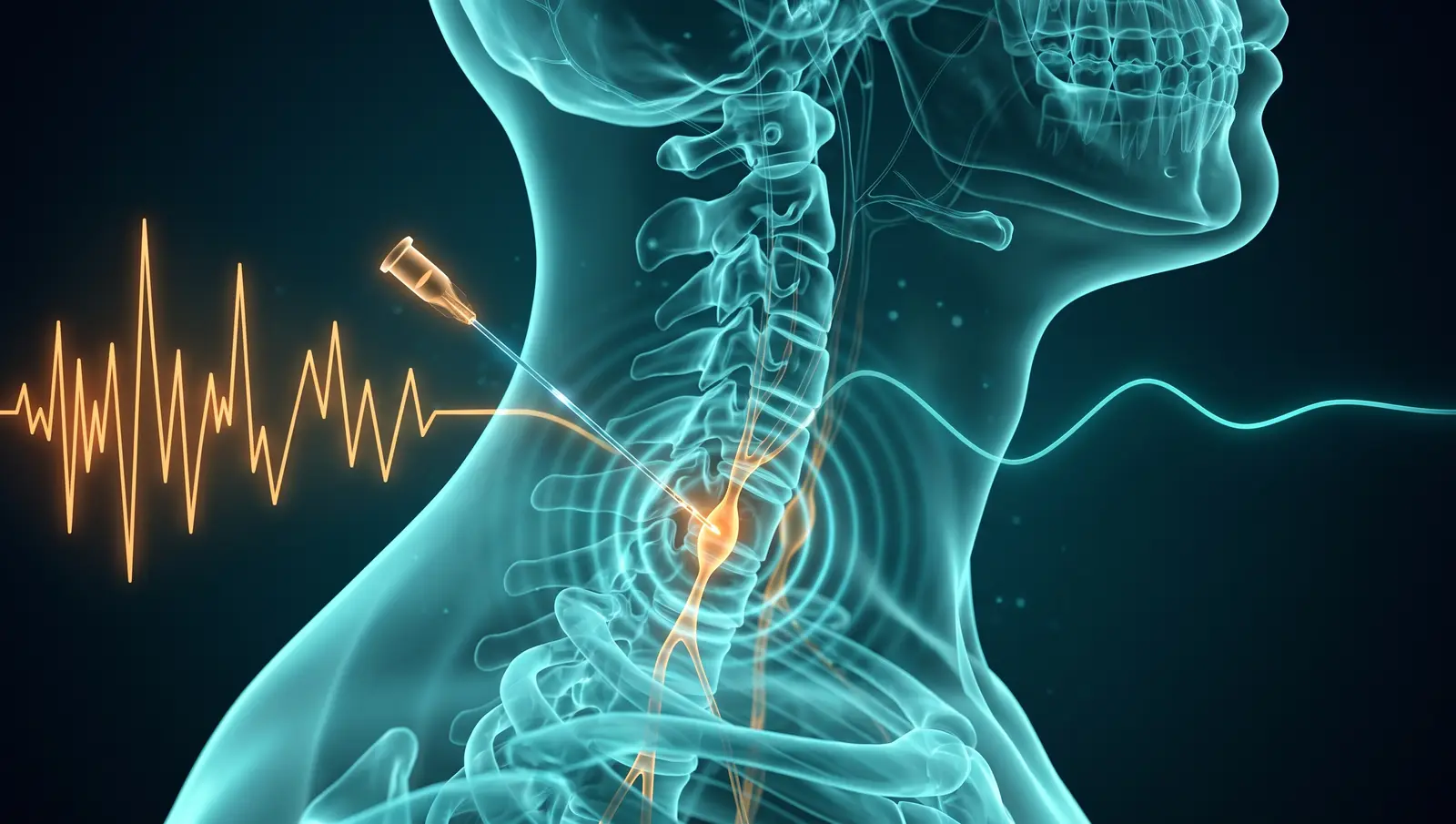
Conceptual artwork for the care discussion. Individual findings and treatment options require clinical evaluation.
Sympathetic overactivity in PTSD and trauma
Trauma changes the nervous system. PTSD is not only a psychological condition — it involves measurable physiological changes in sympathetic tone, amygdala reactivity, and norepinephrine output. The sympathetic nervous system can become chronically activated, maintaining a state of threat readiness long after the threat has passed.
SGB addresses this physiology by temporarily interrupting stellate ganglion output, which reduces cervical sympathetic nerve firing and can lower the sustained norepinephrine release that drives hypervigilance and sleep disruption. The mechanism is physiological rather than pharmacological. It does not replace psychological work — it creates a physiological window where that work is more accessible.
At Neuregen, SGB for trauma is integrated with Domain 6 work: psychological flexibility, behavioral recovery, and limbic system support. Ketamine-assisted psychotherapy may also be considered in the same patient when the clinical picture supports it. These are not competing tools — they address different layers of the same pattern.
Domains most involved:
Every plan starts from the same map: the 7 Domains of Recovery.
How it fits your plan
For PTSD, we review current symptoms, existing support and treatment history. If SGB is considered, its risks, evidence and role alongside ongoing care are discussed before a decision.
An injection is worth discussing only when the evaluation identifies a problem it may address. We consider that problem alongside sleep, movement, autonomic symptoms and daily function, then explain what rehabilitation would involve with or without the procedure.
We review your history, explain the findings, agree on next steps and check how you respond.
Potential Therapies
We use established medicine where it works, and emerging medicine where it makes sense.
These are options to discuss after evaluation, not a predetermined treatment plan. Each label refers to the condition or indication described beside that therapy; evidence can differ for another use. An evidence label does not mean FDA approval.
- Stellate Ganglion BlockEvidence: Emerging
Emerging evidence for PTSD and trauma-related sympathetic overactivity; active clinical investigation ongoing.
- Ketamine-assisted psychotherapy (KAP)Evidence: Emerging
May be considered alongside or sequentially with SGB for PTSD when the clinical picture supports it.
Where the evidence stands
SGB for PTSD and trauma-related sympathetic overactivity is an emerging indication. There is active clinical research and a clear mechanistic rationale — SGB targets the sympathetic chain that sustains the hyperadrenergic state of PTSD — but it is not yet a standard of care for this indication.
Sources and what they support
- VA/DoD clinical practice guideline for PTSD
Recommendation 24 finds insufficient evidence to recommend for or against stellate ganglion block for PTSD. A proposed mechanism is not proof of benefit.
How we grade evidence
Pricing
| Service | Price |
|---|---|
| Stellate ganglion block, single (unilateral) | Confirmed in writing at your Strategy Consultation |
| Stellate ganglion block, bilateral | Confirmed in writing at your Strategy Consultation |
| SGB series within an autonomic-regulation programNumber of blocks set by response, not a fixed package | Confirmed in writing at your Strategy Consultation |
Neuregen is an out-of-network specialty clinic. Most therapies listed here are not covered by insurance; we provide itemized documentation you can submit to your insurer, and we tell you before any therapy which parts, if any, are typically reimbursed.
Financing options are reviewed at your Strategy Consultation before any plan is finalized.
The training behind this care
At Neuregen, the injection discussion sits inside a rehabilitation plan. Our team connects the proposed procedure to findings, practical goals and follow-up instead of treating the procedure as the whole course of care.
Dr. David George: Board certifications and training in functional neurology, integrative psychiatry, and mental health; certified brain injury specialist.
Training most relevant to this area
- Certified Clinical Trauma Professional (CCTP)
- PMHNP-BC
These are the founder’s qualifications. We confirm the treating clinician and their role when discussing your plan.
See Dr. George’s full credentialsFrequently asked questions
Why would a sympathetic nerve block help with PTSD?
PTSD involves a nervous system maintaining a chronic state of threat readiness — hypervigilance, elevated cortisol and norepinephrine, disrupted sleep, exaggerated startle. The stellate ganglion contributes to that sustained output. By temporarily interrupting it, SGB can lower the physiological baseline of the trauma state. This creates a window where psychological and behavioral work becomes more accessible — the nervous system is no longer operating at maximum alert.
Does SGB treat or resolve PTSD?
SGB is not a PTSD treatment in the traditional sense and does not resolve the psychological dimensions of trauma. It is a physiological intervention that targets sympathetic overactivity — one component of the PTSD pattern. At Neuregen it is applied within a plan that also addresses the psychological and behavioral work. The injection addresses the mechanism; the rehabilitation program addresses the person.
How is SGB for PTSD different from medication?
Medications for PTSD — SSRIs, SNRIs, prazosin — work by adjusting neurotransmitter levels or blocking specific receptors, typically over weeks to months. SGB works by directly interrupting the sympathetic nerve chain that drives chronic norepinephrine output and amygdala hyperactivity. The mechanism is physiological rather than pharmacological, and the approaches can complement each other when we determine that is appropriate.
Can SGB and ketamine therapy both be used for PTSD?
Yes — when the clinical picture supports it. SGB addresses the sympathetic overdrive component of PTSD; ketamine-assisted psychotherapy targets the psychological and neuroplastic dimensions. They operate through different mechanisms and can be applied sequentially or in a coordinated plan. We review each case individually to determine what combination, if any, is appropriate.
Is SGB for PTSD evidence-based?
SGB for PTSD carries an emerging evidence level at Neuregen. There is active clinical research, a clear mechanistic rationale, and published clinical data supporting its application — but it is not yet a standard of care for this indication. We discuss the current state of the evidence with each patient before any treatment is recommended.
Start with a Strategy Consultation
If symptoms keep interrupting work, sleep or movement, that disruption is already part of your day. A consultation can help clarify the next question to investigate; it does not commit you to an injection.
8090 N. 85th Way, Suite 100, Scottsdale, AZ 85258 · Mon–Thu, 9:00 AM – 5:30 PM