
Start with what life feels like now
Where might light-based therapy fit in rehabilitation?
We help people with pain that limits sitting, walking or sleeping by examining movement and nervous-system factors so that they can work toward the activities pain has interrupted.
How we look at the whole picture
You plan your day around how long you can sit, stand or walk before pain takes over.
You have tried to keep going, but a sore neck, back or joint keeps bringing you back to the same limits.
You do not need to know which treatment to ask for. Start with what has changed and what you want to be able to do again.
The 7 Domains of Recovery™
Your symptoms may belong in the same conversation.
Pain can involve tissue, movement, nerve sensitivity, sleep and stress. The seven-domain approach considers how these factors may be sustaining the problem.
Neuregen's proprietary 7 Domains of Recovery framework organizes that conversation around seven connected parts of your life and health. We consider all seven, then focus the evaluation on the questions your history raises.
Explore our clinical framework- 1Brain function & neural networks
What has changed in your memory, concentration, balance or sensory tolerance?
- 2Autonomic & nervous system regulation
What happens when you stand, move, rest or encounter stress?
- 3Immune function & neuroinflammation
What immune history, reactions or symptoms need a closer look?
- 4Brain energy & metabolic health
What affects your energy through the day and after activity?
- 5Structure, stability & body-to-brain signals
How do pain, posture, movement and stability affect what you can do?
- 6Psychological flexibility & behavioral recovery
How are mood, stress and patterns of coping affecting your day?
- 7Life, relationships & environment
What demands, relationships and support shape your recovery?
A plan starts with the things you want to do again.
We review the pattern of pain, the examination and any relevant prior imaging. We agree on a functional goal, such as sitting through a meal or walking farther, before choosing care.
01
Tell us what you want your life to look like
We start with what has changed, what you have tried, and the activities you most want to return to.
02
Answer the questions the history leaves open
We review prior reports and select relevant assessments. You should understand what each assessment is meant to clarify.
03
Agree on the priorities and the first steps
We discuss the findings, possible approaches, costs and practical constraints. The plan sets an order that fits your situation.
04
Check what changes and adjust together
We compare your response with the starting point, including daily function. If something is not helping, we discuss what needs to change.
Only then do we discuss which therapies, if any, belong in your plan. The choice depends on the findings, the evidence, your preferences and how you respond.
Talk through your situationRegenerative Therapies · Photobiomodulation
Photobiomodulation (Low-Level Laser & Red Light Therapy)
Red and near-infrared light applied to tissue, and transcranially to the brain, to support cellular energy production within your plan.
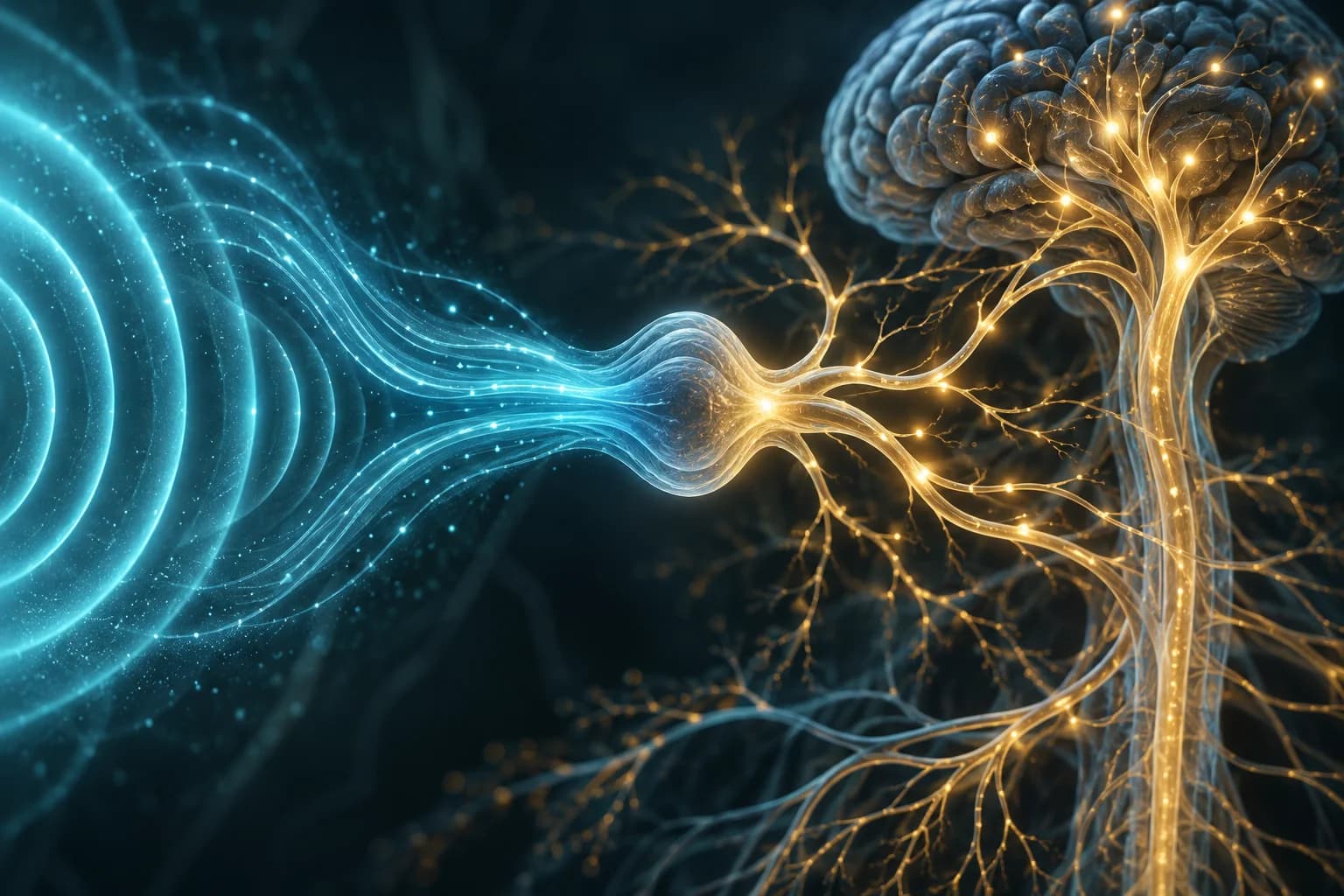
Conceptual artwork for the care discussion. Individual findings and treatment options require clinical evaluation.
What the light does
Photobiomodulation delivers light in the red and near-infrared range at intensities far below those used in surgical lasers. Tissue absorbs it without heating. The best-described target is cytochrome c oxidase, an enzyme in the mitochondrial respiratory chain; light absorption there is associated with increased ATP production, release of nitric oxide from the enzyme, and downstream changes in oxidative stress and inflammatory signaling. That is the rationale for applying it where cellular energy and inflammation are limiting recovery.
Peripheral applications, such as tendon, joint, and myofascial pain, have the longer research record. Transcranial photobiomodulation delivers near-infrared light through the scalp and has been studied in traumatic brain injury, post-concussion symptoms, and cognitive decline in small trials and case series. Results vary between studies, and dose parameters (wavelength, power density, timing) are not yet settled. Neuregen labels this application as emerging and says so on the page and in the consent.
Photobiomodulation is never a standalone service here. We set the parameters after the assessment and schedules sessions around the neurorehabilitation and regenerative work they are meant to support. The escalation principle applies: it is used where the assessment identifies an energy or inflammatory contributor that lower-risk measures have not moved.
Domains most involved:
Every plan starts from the same map: the 7 Domains of Recovery.
How it fits your plan
Light therapy may be considered as an addition to the plan after the evaluation. We explain what it is intended to support and how we would judge whether it is helping.
Interest in a regenerative therapy is a reason to ask questions, not evidence that it fits your condition. We connect any proposed option to the evaluation, review established alternatives and distinguish research mechanisms from demonstrated clinical benefit.
We review your history, explain the findings, agree on next steps and check how you respond.
Potential Therapies
We use established medicine where it works, and emerging medicine where it makes sense.
These are options to discuss after evaluation, not a predetermined treatment plan. Each label refers to the condition or indication described beside that therapy; evidence can differ for another use. An evidence label does not mean FDA approval.
- Transcranial photobiomodulationEvidence: Emerging
Near-infrared light through the scalp as an adjunct in brain-injury and cognitive rehabilitation; dosing parameters unsettled
- Peripheral (musculoskeletal) photobiomodulationEvidence: Emerging
Tendon, joint, and myofascial pain; the longer-studied application
Where the evidence stands
The mitochondrial mechanism is well characterized in laboratory work. Clinical evidence for musculoskeletal pain is larger than for transcranial use, where trials are small and dosing is not standardized. Neither application is a standard of care for the conditions treated here.
Sources and what they support
- FDA information about regenerative medicine therapies
Regulatory and safety information about unapproved regenerative products. This is a disclosure source, not evidence that a product benefits a particular condition.
How we grade evidence
Pricing
| Service | Price |
|---|---|
| Strategy ConsultationA real clinical conversation, not a sales call | Confirmed in writing at your Strategy Consultation |
Neuregen is an out-of-network specialty clinic. Most therapies listed here are not covered by insurance; we provide itemized documentation you can submit to your insurer, and we tell you before any therapy which parts, if any, are typically reimbursed.
Financing options are reviewed at your Strategy Consultation before any plan is finalized.
The training behind this care
Neuregen considers regenerative options within a rehabilitation plan, with condition-specific evidence labels and upfront discussion of experimental status. The purpose is to decide whether an option belongs in your care at all.
Dr. David George: Board certifications and training in functional neurology, integrative psychiatry, and mental health; certified brain injury specialist.
Training most relevant to this area
- NASM Certified Corrective Exercise Specialist
- Ultrasound-guided neural hydrodissection and neural prolotherapy (perineural injection therapy)
- Ultrasound-guided joint injections and nerve blocks
- Regenerative/cellular medicine (PRP, stem cell, exosome therapies)
These are the founder’s qualifications. We confirm the treating clinician and their role when discussing your plan.
See Dr. George’s full credentialsFrequently asked questions
Is photobiomodulation the same as a tanning bed or a heat lamp?
No. Tanning beds emit ultraviolet light, which damages skin. Heat lamps work by warming tissue. Photobiomodulation uses red and near-infrared wavelengths at intensities that do not heat tissue; the intended effect is on cellular energy production, not on temperature or pigmentation.
What does a session feel like?
Most people feel nothing, or a faint warmth from the device housing. Protective eyewear is used when the light is applied near the eyes. Session length and the number of sessions are set by our clinical team from the assessment and adjusted to your response.
What does the evidence say for brain injury and cognition?
Transcranial photobiomodulation has been studied in small trials and case series in traumatic brain injury, post-concussion symptoms, and cognitive decline. Some report improvement; dosing differs across studies and larger controlled trials are still needed. Neuregen labels this use as emerging and does not promise a cognitive outcome.
Can I use a home red-light device instead?
Consumer devices vary widely in wavelength, power density, and how much light reaches the target tissue, and most are not designed for transcranial use. A home device is not a substitute for clinical dosing inside a plan. If you already own one, bring the specifications to your consultation and we will tell you whether it has a role.
Start with a Strategy Consultation
Persistent pain or reduced function may already be changing how you spend your days. A consultation can help you compare options and unanswered questions; there is no deadline to choose an experimental treatment.
8090 N. 85th Way, Suite 100, Scottsdale, AZ 85258 · Mon–Thu, 9:00 AM – 5:30 PM